Parking Lot Snow Removal Winnipeg: Equipment & Staging
- Three pieces of equipment do most parking lot work in Winnipeg, and they’re not interchangeable: plow trucks move snow fast over distance, pushers move high volume in open areas, and loaders stack and reposition
- Lot size and layout decide the equipment mix more than snowfall does: a tight multi-tenant lot and a wide open big-box lot need genuinely different approaches
- Staging is the plan for where snow goes before the first event, not a decision made at 3 a.m. by whoever is holding the controls
- Pile locations have to account for sightlines, drainage at melt, fire lane access, and the parking stalls you’re taking out of service all season
- When a lot runs out of on-site storage capacity, the next step is hauling it off site, which is a separate operation from clearing
Equipment: What Each Machine Is For
A parking lot is a different clearing problem than a driveway or a street, and the equipment reflects that. Most Winnipeg lots are serviced with some combination of three machines, chosen for the site rather than applied uniformly.
Plow Truck
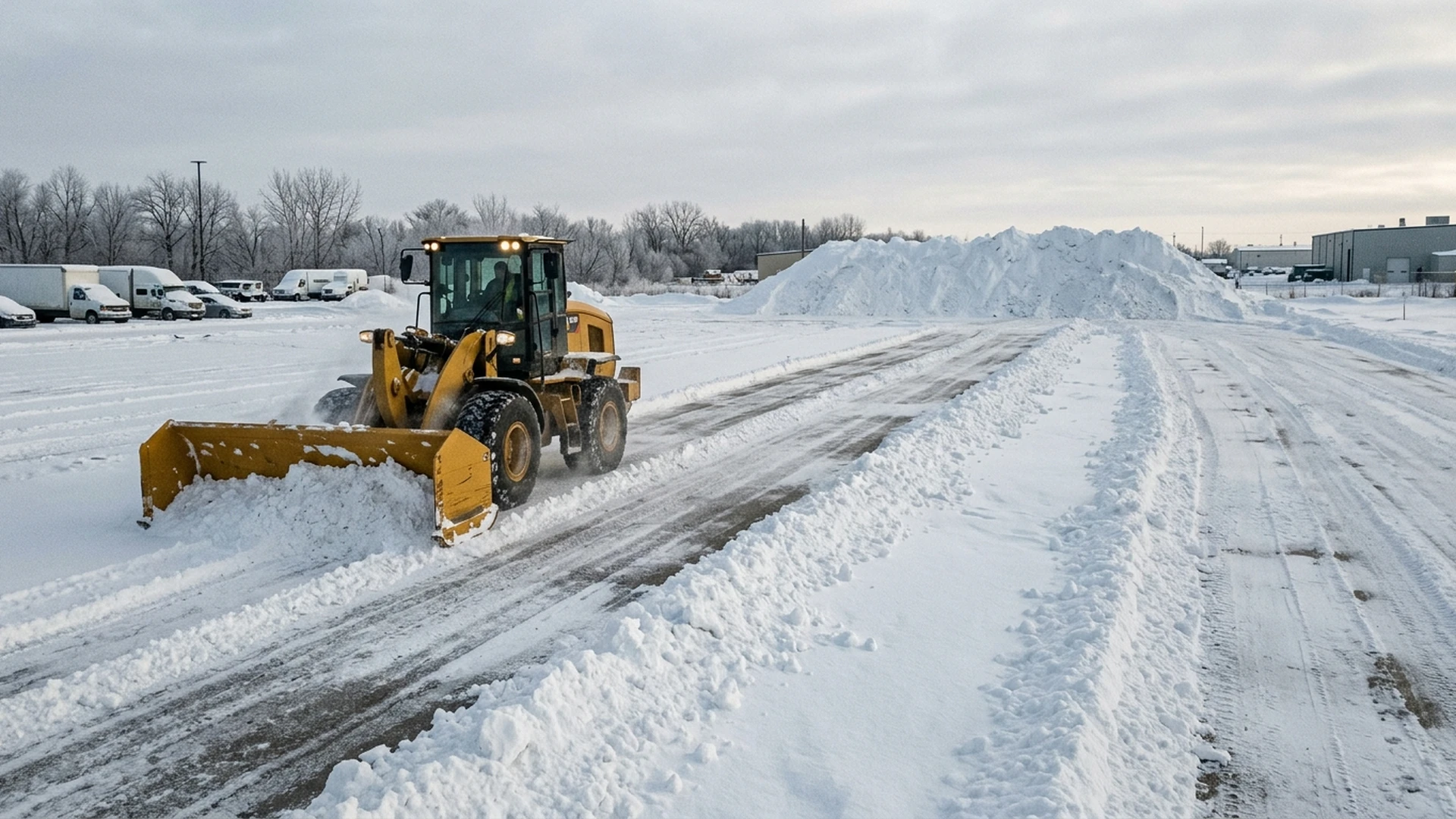
A truck with a front blade is the fastest way to move snow across distance. It’s the workhorse for long drive aisles, access routes, and getting a lot opened up quickly at the start of a service run.
What it’s good at: speed, reach, and windrowing snow along a run toward a pile location. What it isn’t good at: stacking. A truck blade can push a pile up only so far before it’s working against itself, and it can’t lift.
Best suited to
Long aisles, access roads, lots where the priority is opening routes fast, and sites that need a single machine to handle the whole job.
Pusher (Box Plow)
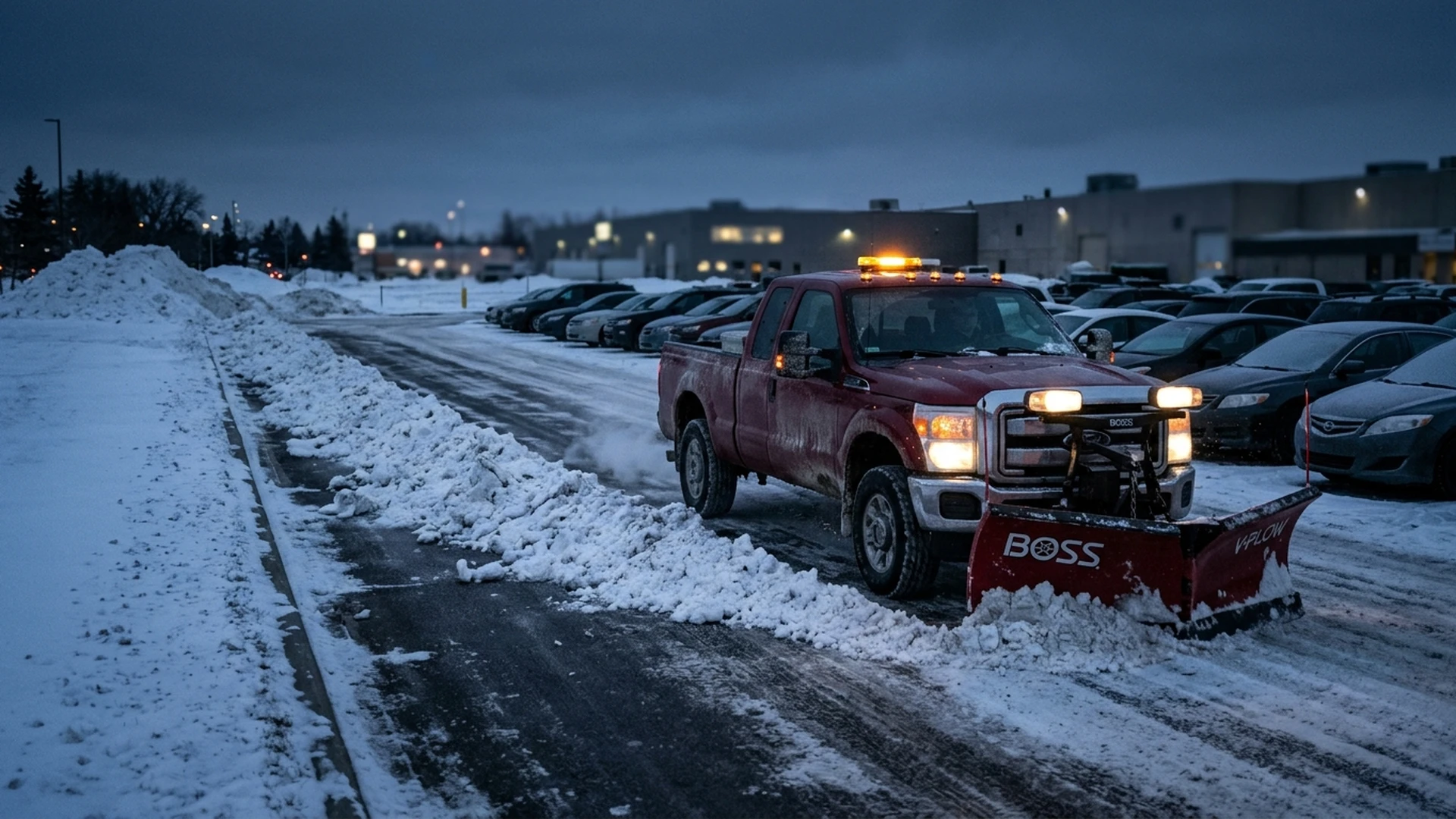
A pusher is a boxed blade with side walls, mounted on a loader or skid steer. The side walls are the point: they stop snow spilling off the ends of the blade, so a pusher carries a full load across the lot instead of losing material the whole way.
On a wide open lot, that changes the economics considerably. A pusher moves far more volume per pass than an angled blade, because nothing escapes sideways. On a tight site with lots of obstacles, the same width becomes a liability.
Best suited to
Open lots, large parking fields, anywhere there’s room to make long straight passes and volume matters more than manoeuvrability.
Loader
A wheel loader does the work neither of the other two can: it lifts. That matters for stacking piles higher as the season goes on, repositioning piles that have grown into the way, and recovering stalls that got buried earlier in the winter.
A loader is also what makes a tight site workable, since it can carry snow to a pile rather than having to push it there in a straight line past parked cars and islands.
Best suited to
Stacking, repositioning, constrained sites, and any lot where piles need to grow upward because there’s no more ground area to spread them across.
Smaller Equipment
Skid steers and compact machines handle the areas the larger equipment can’t reach: between parked vehicles, around islands and bollards, along building edges, and in loading areas. Sidewalk-width machines and crews on foot handle walkways and entrances, which are a different job from the lot surface itself.
Matching Equipment to the Lot
| Lot Type | Typical Mix | Why |
|---|---|---|
| Small lot, tight access, multi-tenant | Skid steer with pusher, or plow truck | Manoeuvrability matters more than volume; a large pusher can’t turn |
| Medium lot with islands and defined aisles | Plow truck for aisles, skid steer for detail | Aisles reward speed, obstacles reward a smaller machine |
| Large open lot | Loader with pusher, plow truck support | Volume per pass dominates; open space suits a wide blade |
| Any lot by mid-winter with large piles | Loader | Stacking and repositioning need lift, not push |
The practical point: a provider showing up with one machine for every property is applying equipment to the site rather than selecting it for the site. What’s on the lot should be a function of what the lot actually is.
Staging: Deciding Where Snow Goes Before the Season
Staging is the plan for how a lot gets cleared and where the snow ends up. It should be settled before the first event, walked with the property contact, and understood by whoever is operating.
Without a plan, the operator makes the call in the dark during the event, and the pile ends up wherever the first pass happened to end. That location then becomes permanent for the season, because once a pile is established it doesn’t move without a loader and a reason.
Clearing Sequence
A lot gets cleared in an order, and the order should reflect how the property is used:
Access routes and drive aisles first, so the lot is enterable and vehicles can circulate
Entrances, loading areas, and accessible stalls early, since these carry the highest use and the highest consequence if missed
Parking fields next, worked in a direction that carries snow toward the designated pile location rather than away from it
Perimeter and detail work last, cleaning up what the larger equipment left
Working toward the pile is the detail that saves the most time. A sequence that pushes snow in the wrong direction early means double-handling it later, which costs hours over a season.
Choosing Pile Locations
Where snow gets staged is a site design decision with consequences that run all winter and into spring.
Sightlines. A pile near an exit, a corner, or an intersection within the lot blocks the view of oncoming traffic and pedestrians once it’s tall. This gets worse through the season as the pile grows, and it’s the issue most likely to turn into an incident.
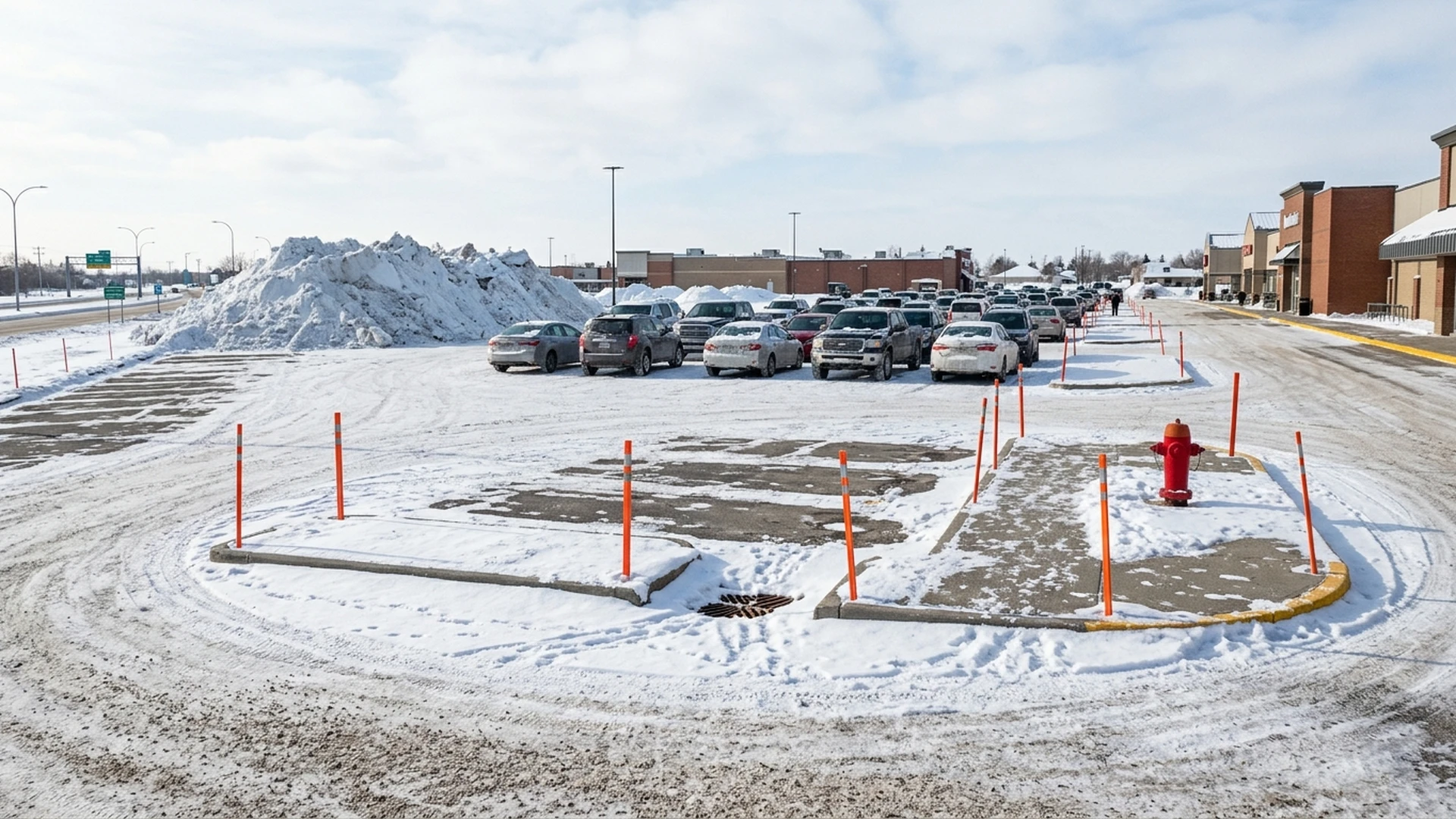
Fire lanes and hydrant access. These can’t be used for storage regardless of how convenient the location is, and piles pushed to the edges tend to encroach inward as winter goes on.
Drainage at melt. A large pile is a concentrated volume of meltwater released in spring. Staged uphill of a building or over a catch basin, it creates a pooling and refreeze problem at exactly the point when the ground is still frozen.
Stalls taken out of service. Every pile occupies parking. Deciding deliberately which stalls get sacrificed, rather than discovering it in January, lets the property plan around it.
Surface and landscaping. Piles sitting on landscaped islands compact soil and can damage plantings; piles sitting against building walls hold moisture against the structure.
Marking the Lot
- Curbs and islands
- Bollards
- Catch basins
- Low fixtures
- The edges of landscaped areas
Before the first snowfall, anything that disappears under snow cover should be marked. Once there’s accumulation, the operator is working from memory, and a blade finding an unmarked curb damages both.
When the Lot Runs Out of Room
Every parking lot has a storage ceiling. Piles grow through the season, stalls stay buried, and eventually pushing snow back stops recovering usable space and starts just relocating the problem into drive aisles.
At that point clearing is no longer the answer, because there’s nowhere left to clear to. The snow has to leave the property, which is a different operation with different equipment: loaders feeding trucks, hauling to a designated disposal site.
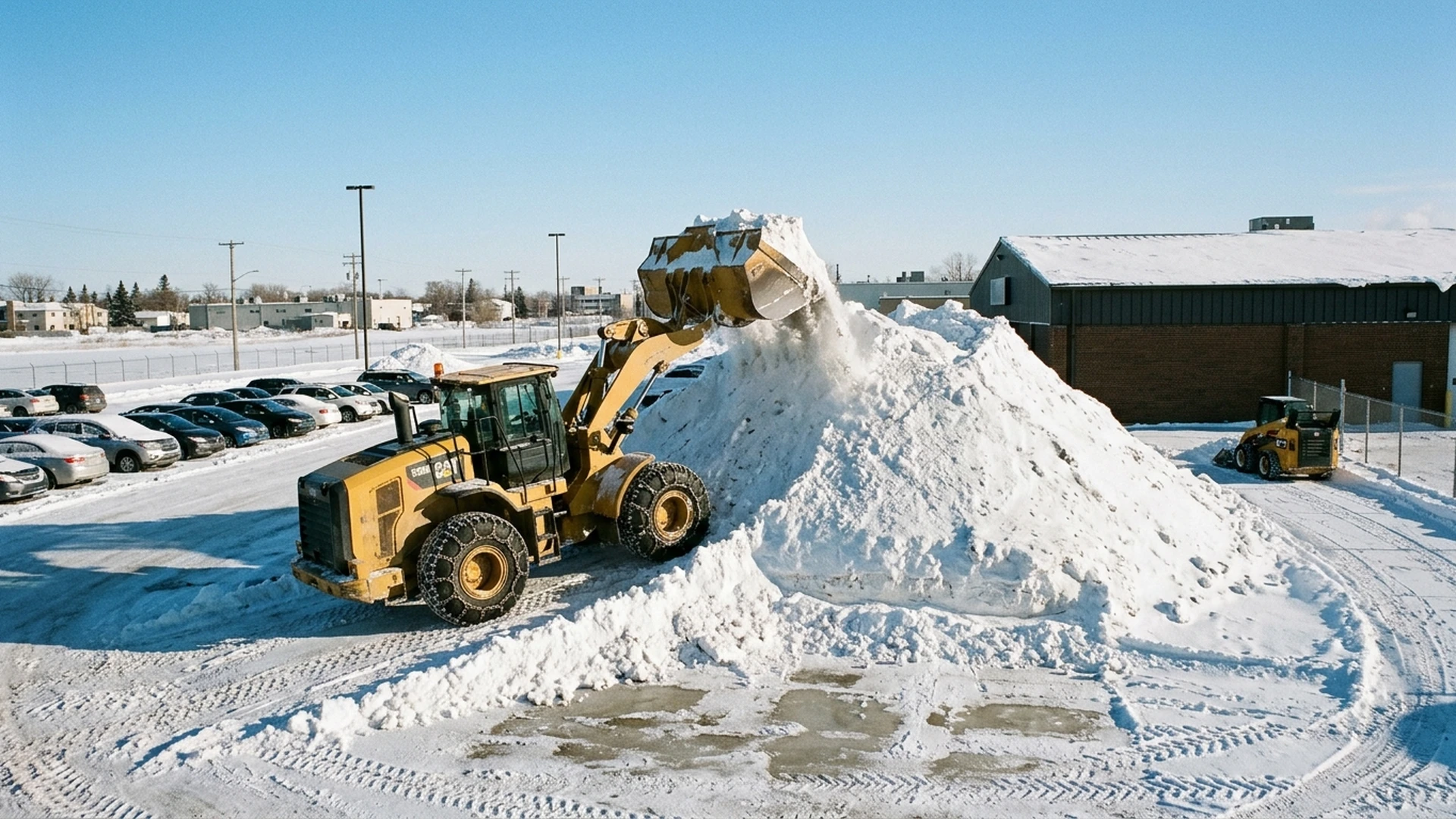
For how that works, including what triggers it, how it’s scheduled, and what drives the cost, see the snow hauling guide from our sister company Ditchfield Supplies.
Where Contracts Fit
Equipment and staging are the operational side. The contract side, including how per-event and seasonal pricing compare, what trigger depth to specify, response time commitments, and the documentation that supports liability management, is covered in our contracts guide for commercial properties. The two conversations are related but separate, and the contract is where the staging plan should be documented.
FAQ: Parking Lot Snow Removal in Winnipeg
Does a bigger machine always clear a lot faster?
Only on a lot with room to use it. A large pusher on a tight multi-tenant site spends more time repositioning than pushing, and the theoretical volume advantage never materializes. The right machine is the largest one that can actually work the site efficiently, which is a different question from the largest one available.
Can we change the pile locations partway through winter?
Yes, with a loader, and it’s sometimes necessary when a pile turns out to be blocking a sightline or taking more parking than expected. It costs equipment time, which is why settling locations before the season is worth the up-front conversation. Mid-season repositioning is a correction rather than a plan.
How much parking should we expect to lose to snow storage?
It depends entirely on the lot’s size, shape, and how much open area exists outside the parking field. A property with landscaped perimeter space loses far fewer stalls than one paved to the property line. The useful exercise is identifying the storage areas during the staging walk and counting the stalls affected, so the number is known rather than discovered.
Talk to Us About Your Lot
Lawn ‘N’ Order services parking lots across West Winnipeg and surrounding areas, with equipment matched to the site and a staging plan settled before the season starts. Get in touch at lawnnorder.ca/get-estimate to walk your property. Outside that area, call and we’ll confirm whether we can service the site.
Use the Free Calculator Book a Free Consultation