Fall Hardscape Installation Winnipeg
- The limiting factor for fall hardscape isn’t cold air, it’s frozen ground. Base compaction and excavation both require workable soil, and that’s what closes the window.
- Interlocking paver work has more late-season flexibility than poured concrete, because concrete has genuine low-temperature curing limits that pavers don’t
- Poured concrete needs sustained temperatures above freezing during the curing period, and cold-weather protection measures add cost and complexity late in the season
- Splitting a project is often the right answer: excavate and build the compacted base this fall, install the surface in spring, which is a legitimate approach rather than a compromise
- If a project genuinely can’t be completed properly this season, starting it and stopping partway is worse than deferring it
What Actually Closes the Window
The instinct is that hardscape season ends when it gets cold. That’s approximately right but misses what’s actually happening, and the distinction matters for deciding what’s still possible in October.
Cold air is an inconvenience for the crew. Frozen ground is a hard stop. Excavation, base preparation, and compaction all require soil that can be dug, moved, and compacted, and Winnipeg’s clay stops cooperating well before deep winter arrives. Once the ground has locked up, the below-grade work that every hardscape installation depends on becomes impractical.
This post is about what’s still feasible late in the season. If you’re planning a project for next year rather than trying to squeeze one in now, our landscape design guide covers the planning side and when to book your landscaping project covers scheduling.
What Can Usually Still Be Built
Interlocking Pavers
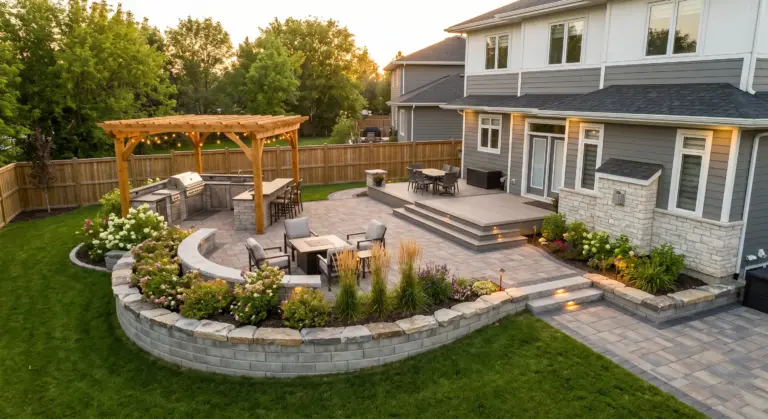
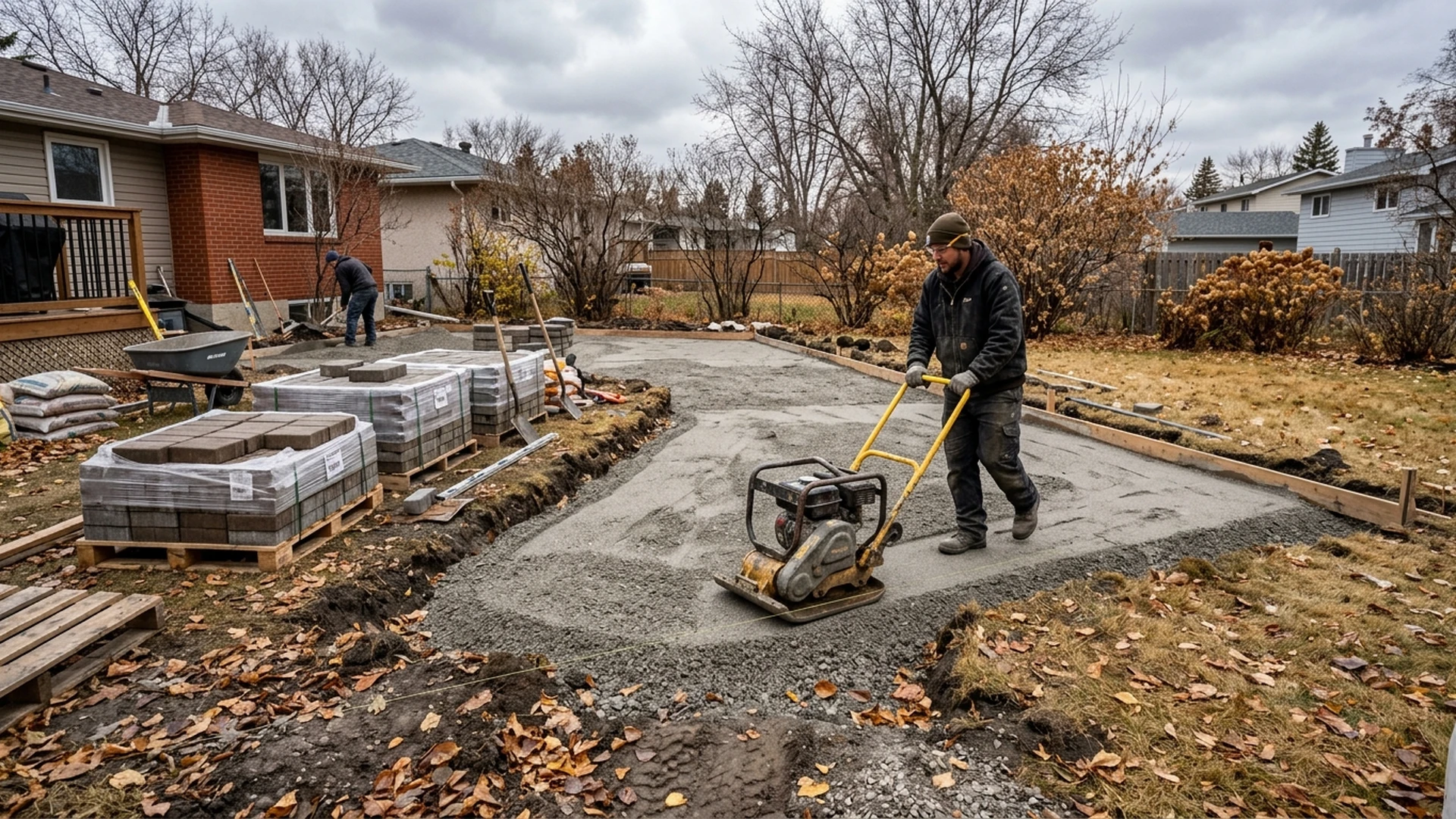
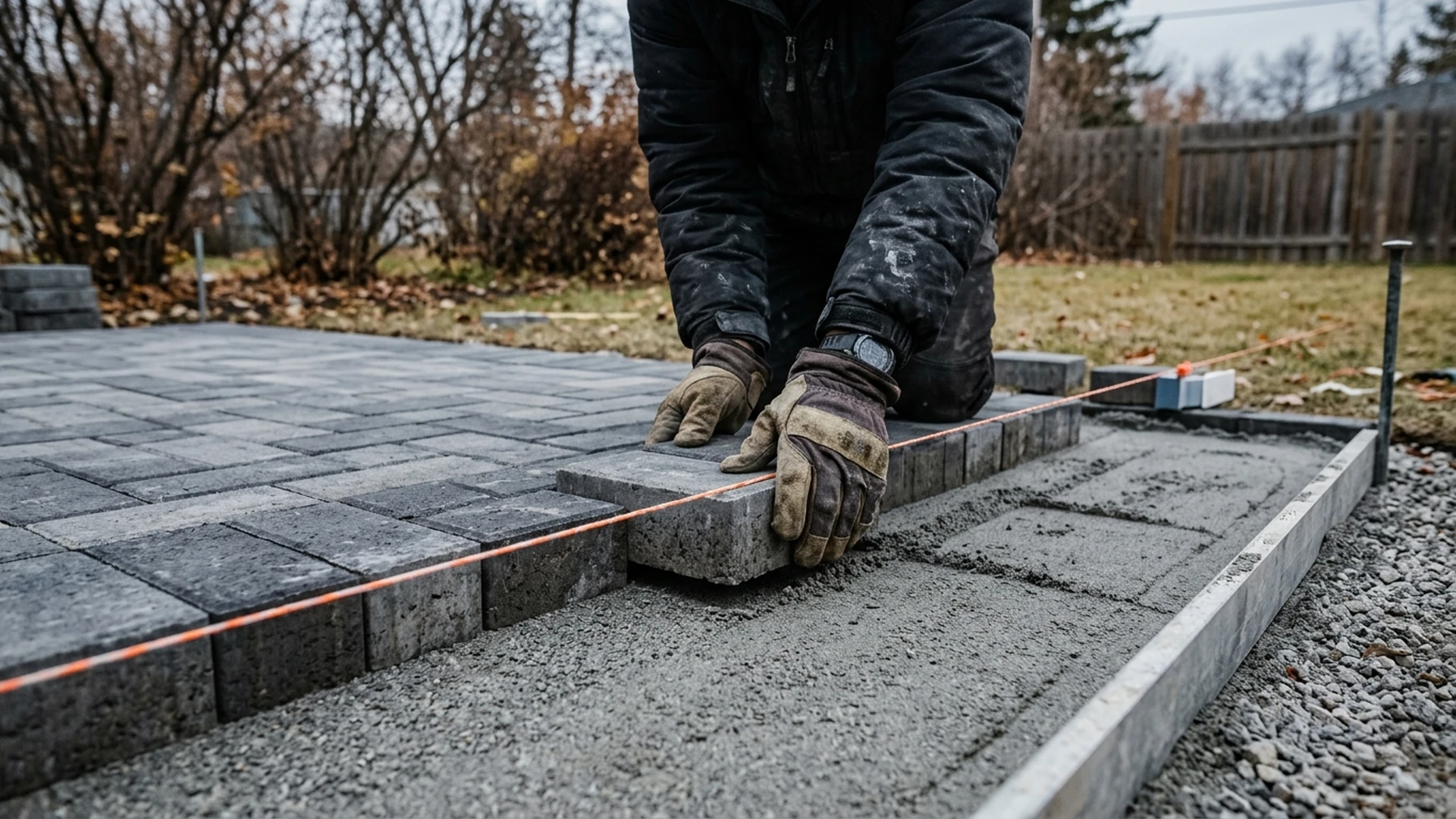
Paver installations have the most late-season flexibility of any hardscape work, because there’s no curing chemistry involved. Once the base is prepared and compacted, laying pavers is a mechanical process that works in cold weather.
The constraint is still the base. Excavation and compaction need workable ground. If the base can be completed while the soil is still cooperative, the surface installation itself can run later into the fall than most people assume.
The one caveat is polymeric sand for the joints, which has a temperature requirement for proper curing. If the installation is finishing late enough that polymeric sand can’t cure properly, jointing may need to wait until spring even though the pavers are down.
For paver project scope and cost, see our patio cost guide.
Segmental Retaining Walls
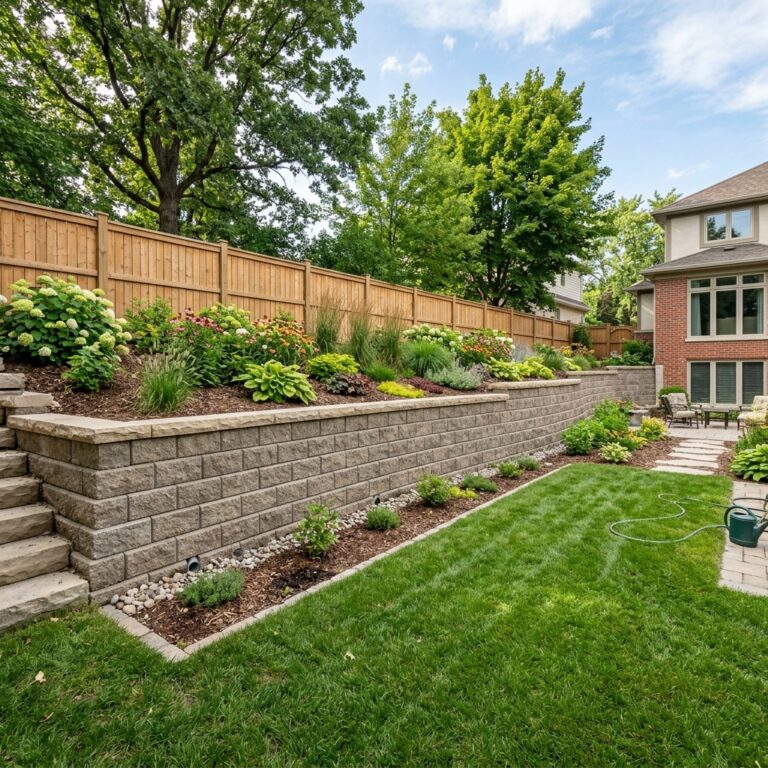
Block retaining walls are similar to pavers in that the assembly itself is mechanical. The base preparation, granular backfill, and drainage installation all need unfrozen ground, but if that work is complete, block placement can continue in cold conditions.
For retaining wall design and construction requirements, see our retaining walls guide.
Dry-Laid Stone and Aggregate Surfaces
Gravel paths, dry-laid flagstone, and similar aggregate surfaces are among the most forgiving late-season projects, since they involve no curing and less critical base preparation than a paver patio carrying regular load.
What Has to Wait for Spring
Poured Concrete
Concrete is the clearest case for deferring. Cement hydration, the chemical reaction that develops concrete strength, slows substantially as temperatures drop and effectively stops near freezing. Concrete that freezes before it has developed adequate strength is permanently compromised, not just slow to cure.
Cold-weather concrete placement is possible with protection measures: heated enclosures, insulating blankets, accelerating admixtures, adjusted mix designs. All of these add cost and complexity, and they have limits. For a residential patio or walkway, the calculation often favours waiting for spring over paying for cold-weather protection on a non-urgent project.
Concrete curbing has the same constraint, since it’s poured in place and cures on site.
Anything Requiring Significant Excavation Once the Ground Is Frozen
Deep footings, drainage trenching, and substantial regrading all need workable soil. Once frozen, these move from difficult to impractical for residential-scale equipment.
Planting and Soil Work
Any softscape component of a hardscape project, bed preparation, sod, planting, needs unfrozen soil and, in the case of plants, establishment time. This is often the piece that pushes a mixed project into spring even when the hardscape itself could proceed.
The Split-Project Approach
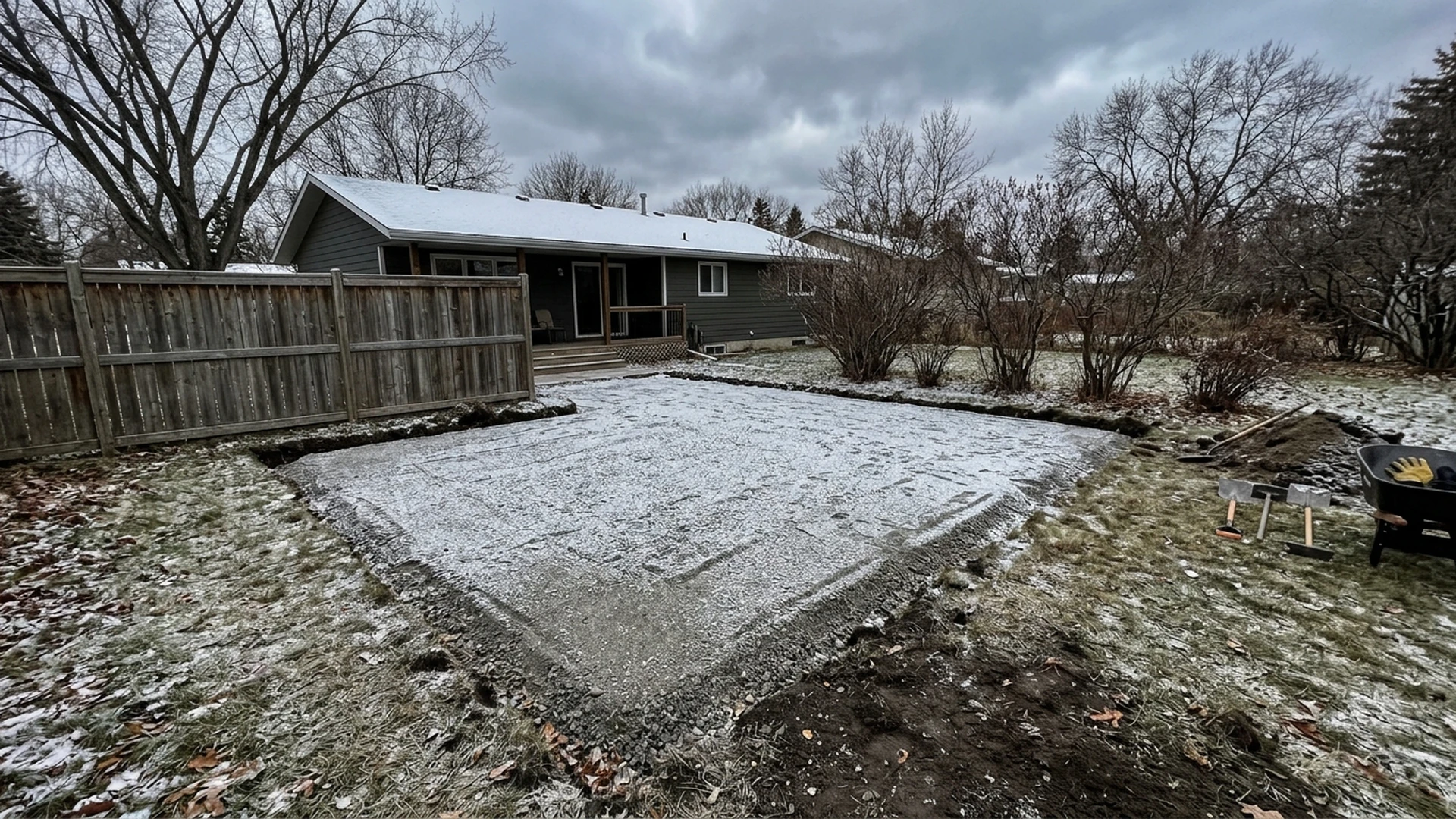
For a project that can’t be fully completed this season, splitting it across the freeze is frequently the better answer than either rushing it or deferring the whole thing.
The natural division follows the ground condition constraint: everything requiring workable soil happens this fall, everything that doesn’t waits for spring.
| Complete This Fall | Wait for Spring |
|---|---|
| Site clearing and excavation | Poured concrete surfaces |
| Compacted granular base | Polymeric sand jointing if temperatures are marginal |
| Drainage installation and backfill | Planting, sod, and bed preparation |
| Retaining wall base and first courses | Final surface finishing and detailing |
A properly compacted base left through the winter is stable. It’s designed to sit below grade and handle freeze-thaw, which is the same thing it does every winter for the rest of its life. Building base in fall and surfacing in spring is a real approach, not a fallback.
Site clearing is the phase that has to happen first and has the earliest deadline. See our site clearing guide for what that phase involves.
What Not to Do
Starting a project that can’t be finished and leaving it exposed through winter. A half-excavated site, an unprotected partial base, or a partially built wall going into a Manitoba winter means a spring that starts with remediation rather than completion.
If the honest assessment is that the season doesn’t have enough left in it, either commit to a defined split with a stable stopping point, or defer to spring. The failure mode is the middle ground: starting without a plan for where the work stops.
How to Decide
A few questions clarify whether a fall start makes sense:
- Does the project involve poured concrete? If yes, that component is almost certainly a spring job.
- Can the excavation and base work realistically be completed before the ground freezes?
- If the project has to stop partway, is there a stable point to stop at?
- Is there a reason this can’t wait until spring, or is the urgency mostly about wanting it done?
FAQ: Fall Hardscape in Winnipeg
Is fall a bad time to install a paver patio?
Not at all, provided the base work can be completed while the ground is workable. Fall installations avoid the spring booking rush, and cooler working conditions are easier on crews than midsummer heat. The constraint is timing on the below-grade work, not any inherent problem with fall as a season.
What happens if a compacted base sits through the winter unfinished?
A properly built and compacted granular base is stable through winter. It’s engineered for exactly those conditions. Some settling or minor surface disturbance can occur, which is addressed with a compaction pass in spring before the surface goes on. This is normal and planned for in a split project.
Can concrete be poured in cold weather at all?
Yes, with cold-weather placement measures, but those add cost and complexity and they have practical limits. For commercial or time-critical work, cold-weather concrete is routine. For a residential patio or walkway that isn’t urgent, the cost of protection measures usually outweighs the benefit of not waiting for spring.
Talk to Us About Your Timeline
Lawn ‘N’ Order can assess whether your project can realistically be completed this fall, or where it makes sense to split it.
Use the Calculator Book a Consultation