
Parking Lot Snow Removal Winnipeg: Equipment & Staging
A plow truck, a pusher and a loader do three different jobs, and the pile you start in November is still there…
Read the article →
A vague "timely service" clause in a commercial snow removal contract protects no one. Manitoba's Occupiers' Liability Act judges liability by the effort made, not just the outcome, which means documentation is what actually protects a property manager after a slip-and-fall claim. Here's the contract structure comparison, the eight elements every commercial agreement needs in writing, and how to evaluate a contractor before the first snowfall.
Residential snow removal is a convenience service. Commercial snow removal is a liability management function with a convenience component attached. A homeowner who does not shovel promptly risks an unpleasant walk to the car. A commercial property owner or manager who does not clear a parking lot or walkway promptly risks a slip-and-fall claim, potential liability exposure, and in a multi-tenant property, complaints and lease disputes.
This changes what a commercial contract needs to specify. Response time, documentation, liability allocation, and service scope all need to be defined precisely, in writing, before the first snowfall, rather than handled informally as issues arise.
Manitoba property owners and managers have a duty of care to maintain reasonably safe conditions on their property, including reasonable snow and ice management.
This duty is codified in Manitoba’s Occupiers’ Liability Act (C.C.S.M. c. O8), section 3(1), which requires an occupier to take reasonable care to ensure that people on the premises are reasonably safe. Manitoba courts have held that this duty is judged by the efforts made, not simply the outcome: liability turns on whether a reasonable snow and ice management system was in place and was actually followed, not on whether every patch of ice was eliminated. A slip-and-fall injury on a commercial property during or after a snow event, where the property owner cannot demonstrate that reasonable effort, creates meaningful liability exposure.
The property manager’s best protection against this exposure is not just having a snow removal contract, but having a contract with a contractor whose service quality, response time, and documentation practices actually stand up to scrutiny after an incident. A contract that exists on paper but that the contractor does not actually execute promptly and thoroughly provides little practical protection.
When a slip-and-fall claim is filed, the property manager’s defence depends heavily on being able to demonstrate that reasonable steps were taken. The documentation that supports this:
Time-stamped service records showing when snow removal was performed relative to when the snowfall ended
Photos or records showing the condition of the property before and after service
A written contract specifying the response time commitment and the trigger conditions for service (e.g., service begins when accumulation reaches 2.5 cm)
Records of any ice management (salt, sand, or other de-icing material application) separate from snow clearing
A verbal arrangement or an informal understanding with a contractor provides none of this protection. For any commercial property, a written contract with defined service triggers and documented service records is the baseline, not an enhancement.
Per-event contracts bill for each snow removal service performed, typically triggered when accumulation reaches a specified depth (commonly 2.5 cm or 5 cm). The property pays only for services actually performed, which can be cost-effective in a low-snowfall winter but creates budget unpredictability in a heavy winter. Per-event contracts require clear specification of the trigger depth, the response time from trigger to service completion, and whether additional services (ice management, walkway shovelling, entrance clearing) are included in the per-event rate or billed separately.
A seasonal contract bills a fixed rate for the full winter season, covering an unlimited or capped number of service events. This provides budget predictability, which is valuable for property managers working within an annual operating budget approved well in advance. The contractor assumes the weather risk: a heavy snowfall season costs the contractor more to service without additional revenue, while a light season is more profitable for them. Seasonal contracts should specify what happens in an exceptional event: a single storm depositing 30+ cm in a short period may require service beyond what a normal seasonal rate anticipates.
Some commercial contracts combine a base seasonal rate for standard service with per-event surcharges for extreme weather events above a defined threshold. This balances budget predictability for normal winters with fair cost allocation for exceptional events.

Before winter, agree on a site plan and written scope for the areas that need clearing. Property managers should confirm:
Confirm response windows, trigger depths and ice management in the contract for your specific property.
| Contract Element | Why It Matters |
|---|---|
| Trigger depth for service initiation | Defines when the contractor’s obligation to act begins |
| Response time commitment (hours from trigger to completion) | The specific, enforceable standard for timeliness; vague language protects no one |
| Scope: parking lot, walkways, entrances, loading areas | Commercial properties often have zones with different priority and different equipment needs |
| Ice management and de-icing material application | Often a separate service from snow clearing; specify whether it is included |
| Service documentation and reporting | What records the contractor provides and how quickly after each event |
| Liability insurance requirements | Confirm the contractor carries adequate commercial general liability coverage |
| Multi-year term vs annual renewal | Affects pricing stability and contractor familiarity with the property |
| Exceptional event provisions | How major storms beyond normal seasonal scope are handled |
Beyond price, the questions that matter for a commercial property manager evaluating snow removal contractors:
Does the contractor have equipment appropriately sized for the property? A contractor undertaking multiple commercial properties in the same weather event needs enough equipment and crew capacity to service all of them within the committed response time, not just the capacity to handle one property well.
Ask for references from other commercial or multi-unit properties the contractor currently services, and ask specifically about response time reliability during major snow events, not just routine service.
Confirm the contractor carries commercial general liability insurance at a level appropriate to the property, and request a certificate of insurance naming the property as an additional insured if that is standard practice for the property’s risk management approach.
Ask specifically what records the contractor provides after each service event and how quickly they are available. A contractor who cannot describe their documentation process clearly may not have one.

Property managers overseeing multiple commercial or condominium properties benefit from a standing contractor relationship rather than individually negotiated contracts for each property. A single contractor servicing a portfolio can offer more consistent service standards, simplified invoicing and reporting across properties, and often more favourable pricing at portfolio scale than individually negotiated single-property contracts.
Lawn ‘N’ Order services commercial and condominium properties, primarily in West Winnipeg and surrounding areas, through our property maintenance division, which also handles landscaping maintenance during the growing season. For property managers, a single contractor relationship across both snow removal and landscape maintenance simplifies vendor management. See our property maintenance page for the broader property management service context.
What response time should a commercial snow removal contract specify?
This depends on the property type and use pattern. A retail property with customer parking open during business hours typically needs service completed before opening, which may mean the contractor is on site during overnight hours as snow accumulates. An office property with a defined opening time has a similar requirement. The specific number of hours should be negotiated based on the property’s operating hours and risk tolerance, but it should be a specific number in the contract, not a general commitment to promptness.
Who is liable if someone slips on ice in a commercial parking lot?
Liability determination depends on the specific circumstances, including whether reasonable snow and ice management was in place and executed. This is a legal question that depends on case-specific facts; property managers with liability concerns about a specific incident should consult legal counsel. The practical risk management approach is maintaining a documented, responsive snow removal contract that demonstrates reasonable care was taken, which is the strongest general protection available. Note also that some provinces have introduced a notice-of-claim requirement for snow and ice injuries, extending to independent contractors hired to remove snow, separate from an occupier’s underlying liability. Whether an equivalent requirement is currently in force in Manitoba should be confirmed with legal counsel, as it would affect contractors directly, not just property owners.
Should ice management be a separate line item from snow removal?
Many commercial contracts separate these because they are triggered by different conditions and serve different functions. Snow removal addresses accumulation; ice management (salting, sanding) addresses the freeze-thaw conditions that create slip hazards even without fresh snowfall. A property with significant pedestrian traffic often needs ice management triggered independently of snow accumulation, for instance, after a freeze-thaw cycle creates ice on a previously clear surface.
Lawn ‘N’ Order provides commercial snow removal contracts for condominium, retail, and office properties, primarily serving West Winnipeg and surrounding areas. Call to confirm service availability for your specific location.
Request a Commercial Snow Quote Explore Snow Removal ServicesSend the address and a rough idea of scope. We'll walk it, take levels, and give you a written number you can compare line for line.
Keep reading
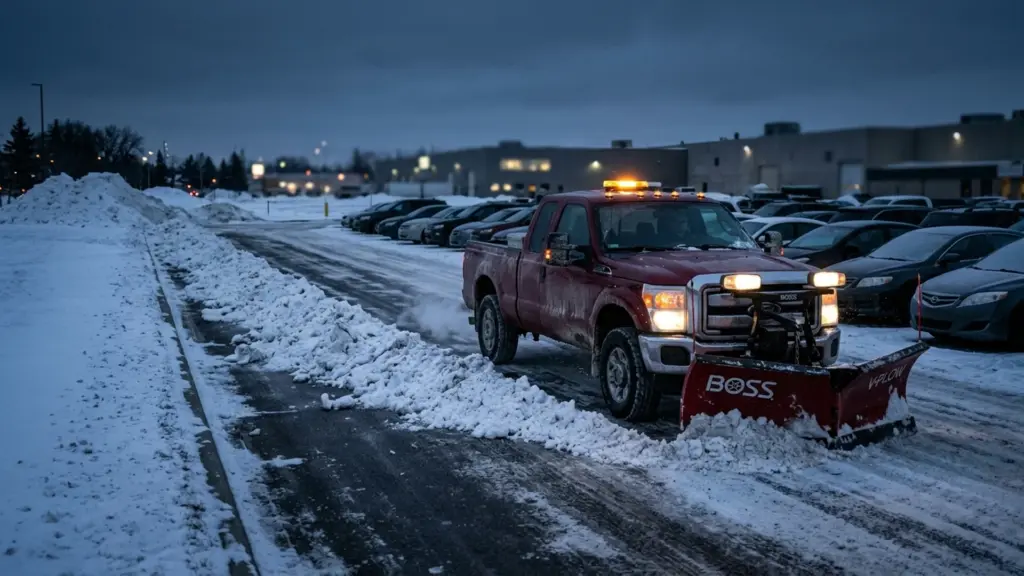
A plow truck, a pusher and a loader do three different jobs, and the pile you start in November is still there…
Read the article →
Holiday Light Installation Winnipeg: Book Before the Ground Freezes Quick Takeaways Holiday light installation in Winnipeg has a short window: crews install…
Read the article →
Who Clears the Sidewalk in Winnipeg? What the City Does and What You’re Responsible For Quick Takeaways Winnipeg is one of the…
Read the article →