
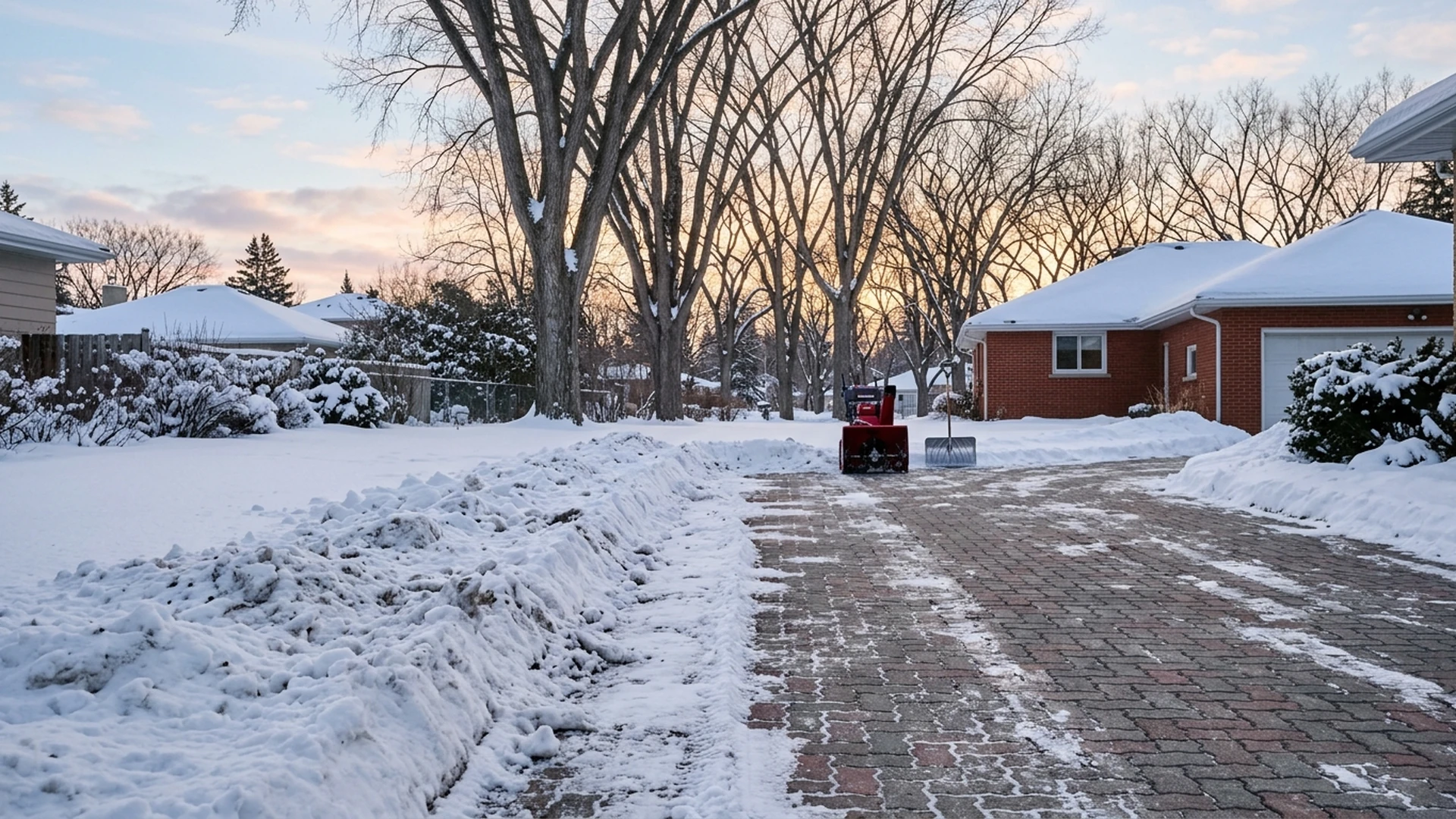
Snow Blowing vs Plowing in Winnipeg: Which Suits Your Driveway
Compare snow blowing and plowing for a Winnipeg driveway, including snow storage, driveway layout and the surface beneath the snow.
Quick Takeaways
- The whole difference comes down to one thing: a blower throws snow somewhere else, a plow pushes it into a pile. Every other consideration follows from that.
- Narrow driveways and tight city lots often favour throwing, because there is nowhere good to push a pile. Long or double driveways usually favour pushing, because it moves more volume per pass.
- Driveway surface matters more than most homeowners expect, and gravel is the clearest case: a blade drags stone into the lawn, and an auger throws it.
- Interlocking pavers, stamped concrete, asphalt and plain concrete each have a specific vulnerability, and most of them come down to how the equipment contacts the surface.
- The right answer is site-specific. Driveway shape, surface, where the snow can legally go and what is buried under it all change the recommendation.
The Physical Difference
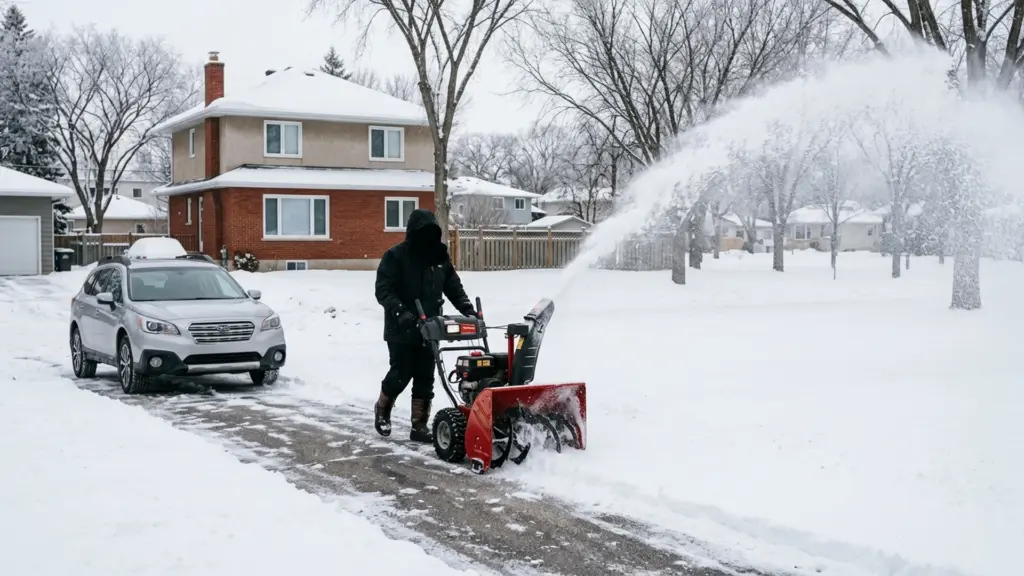
A snow blower takes snow in through an auger, moves it to an impeller and throws it out of a chute, usually ten to thirty feet depending on the machine and the snow. The snow leaves the driveway as a wide, loose spray. A plow or pusher does not move snow off the driveway at all. It collects snow in front of a blade and relocates it to the edge of the cleared area as a pile.
That distinction decides almost everything else. A blower needs somewhere for the snow to land. A plow needs somewhere for the pile to sit, and needs that space to still exist in February. A blower makes several slower passes and moves snow by volume per minute. A plow makes fewer, faster passes and moves snow by the blade-width.
The two also behave differently as the winter wears on. A blower is largely unaffected by how much snow is already banked at the edges, because it throws over them. A plow is progressively constrained by its own piles, which is why a driveway cleared by blade in December can have noticeably less usable width by March.
Where the Snow Ends Up
Both methods have to put the snow somewhere, and in Winnipeg where it can go is governed by rules rather than preference. Snow cannot be pushed or thrown onto the street, onto a neighbour’s property or onto the public sidewalk. That is covered in detail in who clears the sidewalk in Winnipeg, including the windrow question and what the City does and does not clear, so this post will not re-cover it.
The practical point for this comparison is that the rules constrain each method differently. A blower’s chute can be aimed, but only as far as the machine throws, which means the receiving area has to be within range and has to be yours. A plow’s pile has a fixed location determined by the geometry of the driveway, and that location has to be able to absorb a season’s worth of snow.
Driveway Shape and Size
Narrow City Driveways
A single-width driveway on an older Winnipeg lot often has nowhere sensible to put a pile. The strip between the driveway and the house is too narrow, the other side belongs to the neighbour, and the street end is off limits. Pushing the snow simply relocates the problem to the only two spots that are already tight: the front of the garage and the apron at the street. Throwing the snow onto the front lawn or the side yard uses space a pile cannot reach.
Long or Double Driveways
On a long driveway or a double-width one, pushing generally wins on efficiency. There is more volume to move, the geometry allows a pile at the far edge or at the back, and a blade clears a wide path in a single pass. A blower on the same driveway takes considerably longer, because it is limited by how fast it can take snow in rather than how fast the machine can travel.
Shared Driveways
A shared driveway between two houses has no neutral ground to pile on, and anything pushed to one side becomes somebody else’s problem. Throwing avoids creating a pile that sits on a boundary, but it needs a clear receiving area and an agreement with the neighbour about where the snow goes. This is worth settling in November rather than after the first real storm.
Back Lane Garages
Lane access adds a second cleared area with its own constraints. The apron behind the garage is usually short, the lane itself is a City responsibility on its own schedule, and the space beside the garage is often fenced. Many lane-access properties end up wanting different handling at the front and the back, which is a normal outcome rather than a complication.
The Surface Under the Snow
This is the part homeowners most often discover the hard way, usually in April. The equipment contacts the driveway surface, and different surfaces respond to that contact differently.
Gravel Driveways
Gravel is the clearest case and the one with the most visible consequences. A plow blade riding on a gravel surface does not distinguish between snow and stone. It drags both, and the stone ends up in the lawn along the edge of the driveway. Over one winter that means a thinner driveway, a strip of lawn full of stone and a spring morning spent raking it back. It also means the mower finds whatever was missed.
A blower on gravel has a different failure mode. The auger will pick up loose stone and the impeller will throw it, which is bad for windows, siding, vehicles and anyone standing nearby, and hard on the machine. Height is adjustable, so this is manageable, but it has to be managed deliberately rather than assumed.
The practical approach for gravel in Winnipeg is to let an early packed base form and clear above it rather than down to the stone, and to set the equipment to ride high whichever method is used. A driveway cleared to bare gravel every storm is a driveway being slowly moved into the lawn. This is also worth raising before the first clearing rather than after, because the first pass sets the base for the rest of the winter.
Interlocking Pavers
Paver driveways have two sensitivities. The first is the joints: joint sand is already subject to loss over the years, and aggressive clearing speeds that up. The second is level. Freeze-thaw movement in Winnipeg clay can lift individual pavers slightly out of plane, and a steel cutting edge travelling at speed will catch a raised edge and chip it or pull the unit. A rubber or polyurethane cutting edge, or shoes set to ride just above the surface, largely solves this. For how paver driveways behave against poured concrete over a Winnipeg winter, see interlocking stone vs concrete driveways.
Stamped and Decorative Concrete
Stamped concrete is a textured surface, which is exactly the problem. The raised pattern gives a blade something to catch, and repeated contact wears the sealer unevenly, which shows as soon as the snow is gone. Clearing stamped concrete favours riding above the surface rather than scraping to it, which in practice means accepting a thin layer of snow and managing traction separately.
Asphalt
Asphalt is softer than concrete and its edges are its weak point, particularly on older driveways where the edge has already started to crumble. A blade that catches an edge takes a piece of it. Asphalt also holds heat differently and can develop an ice bond at the surface, which is a traction question rather than a clearing-method question.
Plain Poured Concrete
A sound poured concrete driveway is the most forgiving surface for either method. The concerns are expansion joints, any existing spalling, and the apron, which usually takes the most abuse. It is the surface where the choice between throwing and pushing can be made almost entirely on driveway geometry rather than on protecting the finish.
| Surface | Main risk | What reduces it |
|---|---|---|
| Gravel | Stone dragged into the lawn or thrown by the impeller | Clear above a packed base, set equipment high |
| Interlocking pavers | Joint sand loss, chipped or pulled units at raised edges | Non-metal cutting edge or shoes riding above the surface |
| Stamped concrete | Blade catching the raised pattern, uneven sealer wear | Clear above the surface, handle traction separately |
| Asphalt | Crumbling edges caught by a blade | Define the edges, avoid scraping at the perimeter |
| Poured concrete | Expansion joints and existing spalling | Choose the method on geometry, watch the apron |
What Is Buried Under There
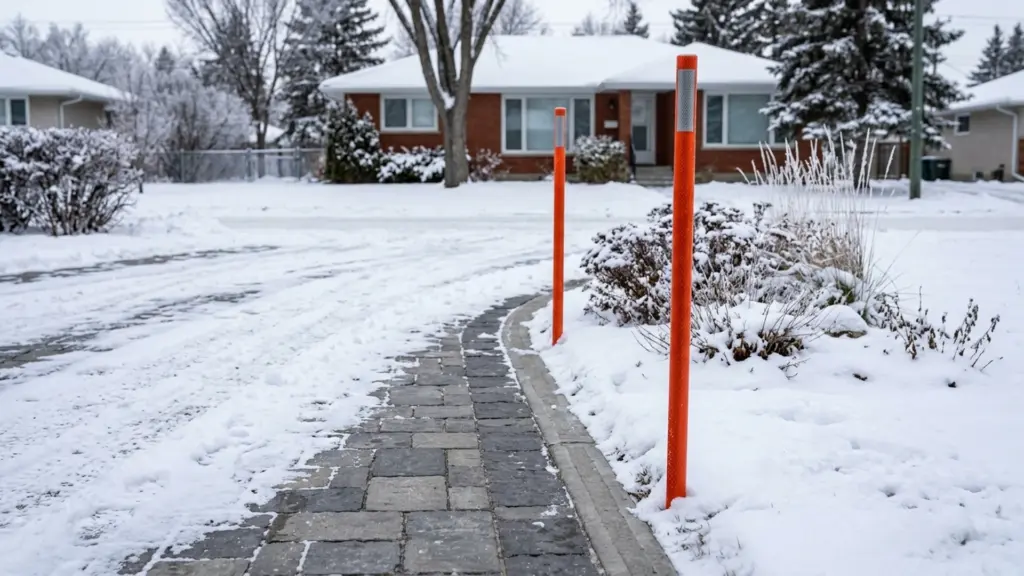
Both methods are blind to anything under the snow. Landscape lighting, irrigation heads, bed edging, a low wall and the lawn along the driveway edge are all invisible by the second storm, which is why the edges of a driveway get damaged far more often than the middle. Marking a driveway before the snow arrives covers staking, what to flag and how damage gets handled, so it is not repeated here.
Traction Is a Separate Question
Neither method removes the compacted layer that forms under traffic, and neither addresses ice. Clearing and ice control are two different jobs, which is why a driveway can be perfectly clear and still be the most dangerous surface on the property. Winter sanding covers that side of it.
How This Gets Decided in Practice
There is no single right method for Winnipeg driveways. The variables that decide it are mostly ones that cannot be assessed over the phone: driveway dimensions, where a pile could legally and practically sit, the surface and its current condition, what is planted or installed along the edges, the slope toward or away from the garage, and whether there is lane access to handle as well. Those are worth walking through before the season starts, whoever is doing the work.
Scope of service is a separate matter again. What a seasonal arrangement covers, how many visits it includes and what triggers a visit are covered in what a residential snow removal contract actually covers. For commercial properties, where the equipment question is driven by lot size and staging rather than driveway surface, see the parking lot snow removal guide.
FAQ: Driveway Snow Removal in Winnipeg
I have an interlocking paver driveway. Which method should I use?
Either can work on pavers. What matters more than the choice is what contacts the surface. A rubber or polyurethane cutting edge, or equipment set to ride slightly above the pavers rather than scrape them, protects both the joint sand and any unit that has lifted slightly out of plane over the years. If a paver driveway has visible movement already, that is worth looking at before winter rather than after.
What do I do with a gravel driveway in winter?
Stop trying to clear it to bare stone. The approach that works in Winnipeg is to let a compacted snow base form in early winter and clear above it for the rest of the season, with the equipment set high either way. You give up a little traction underfoot and keep your driveway out of your lawn. Plan on topping up gravel in spring regardless, because some loss over a winter is normal, but there is a large difference between topping up and rebuilding.
Does one method handle the heavy wet snow better?
Heavy wet snow is hard on both, in different ways. It is the condition most likely to clog a blower chute, and it is the condition where a blade is pushing the most weight and where the pile freezes hardest once it settles. In deep heavy snowfall the practical difference is often less about the method and more about how soon the driveway gets cleared, because wet snow left to sit and then driven on becomes a different job entirely.
Can the snow go on my front lawn?
Snow on your own lawn is generally fine, though repeatedly piling in the same place compacts the ground and the turf under a hard pile is slower to come back in spring. What is not permitted is putting it on the street, the public sidewalk or a neighbour’s property. The sidewalk guide covers where responsibility sits and what the City expects.
Have Your Driveway Looked At
The right handling for your driveway depends on things that have to be seen: the surface, the space available for snow, the edges and what is planted or installed along them. Lawn ‘N’ Order will walk the property and assess it before quoting. Snow services primarily cover West Winnipeg and surrounding communities, so call to confirm coverage for your address. See snow removal services to arrange an assessment.