
Parking Lot Snow Removal Winnipeg: Equipment & Staging
A plow truck, a pusher and a loader do three different jobs, and the pile you start in November is still there…
Read the article →
Most homeowners install task lighting only and wonder why the pool area feels flat at night. Effective pool and patio lighting is built in three layers: ambient uplighting first, task lighting for safety second, accent lighting for drama last. Here's the layering sequence, the fixture specs that survive Winnipeg's freeze-thaw cycle, and how the three layers work together rather than as one flat wash of light.
A pool and patio setting is the highest-demand lighting environment in a residential landscape. It combines multiple overlapping functions: safety (water edges, steps, trip hazards), ambiance (the quality of light that makes an evening space feel welcoming), and feature enhancement (the pool, water features, architectural plantings). A single fixture type handles none of these functions well. A designed layering approach handles all of them.
For context on landscape lighting fundamentals, types, and the broader role of lighting in a Winnipeg yard, see our landscape lighting guide. This post focuses on the specific layering craft applied to pool and patio settings.
The ambient layer is the foundation. It determines the perceived brightness and mood of the entire space before any specific features are highlighted. In a pool and patio setting, ambient lighting comes primarily from two sources: uplighting the structural elements and trees that frame the space, and any overhead lighting within a pergola or covered structure.
Uplighting trees that surround the pool area creates a canopy of reflected light that illuminates the space without direct glare. A mature cedar hedge uplit from below produces a soft, diffused light wall that defines the boundary of the space and eliminates the harsh visual edge of a dark perimeter. Ornamental trees uplit at the base create vertical light columns that anchor the space visually.
Fixture placement: set the fixture 12 to 18 inches from the base of the tree or shrub, angled at approximately 45 degrees upward. Burying the fixture slightly below grade keeps it out of the mowing path. For freeze-thaw durability in Winnipeg, choose cast-aluminum or brass housings over plastic; the fixture will go through dozens of freeze-thaw cycles over a season.
A pergola or pavilion over a patio creates a natural opportunity for ambient lighting integrated into the structure itself. Recessed downlights in a solid-roof pavilion, string lights threaded through an open pergola rafter, or track lighting on a covered beam all produce ambient downward light that illuminates the dining or seating surface without requiring separate overhead fixtures on poles or posts.
Structure-integrated lighting is most effective as warm white (2700K to 3000K colour temperature). Cool white or daylight temperatures read as sterile and clinical in an outdoor living setting; warm white reads as welcoming. For pool surround pergola and structure design, see our pool landscaping guide and pergola vs pavilion comparison.
Task lighting serves safety. It illuminates the specific surfaces and transitions where trips, falls, and disorientation in the dark are risks. In a pool and patio setting, the three primary task lighting locations are paths to and from the pool, steps between grade changes, and the pool edge.
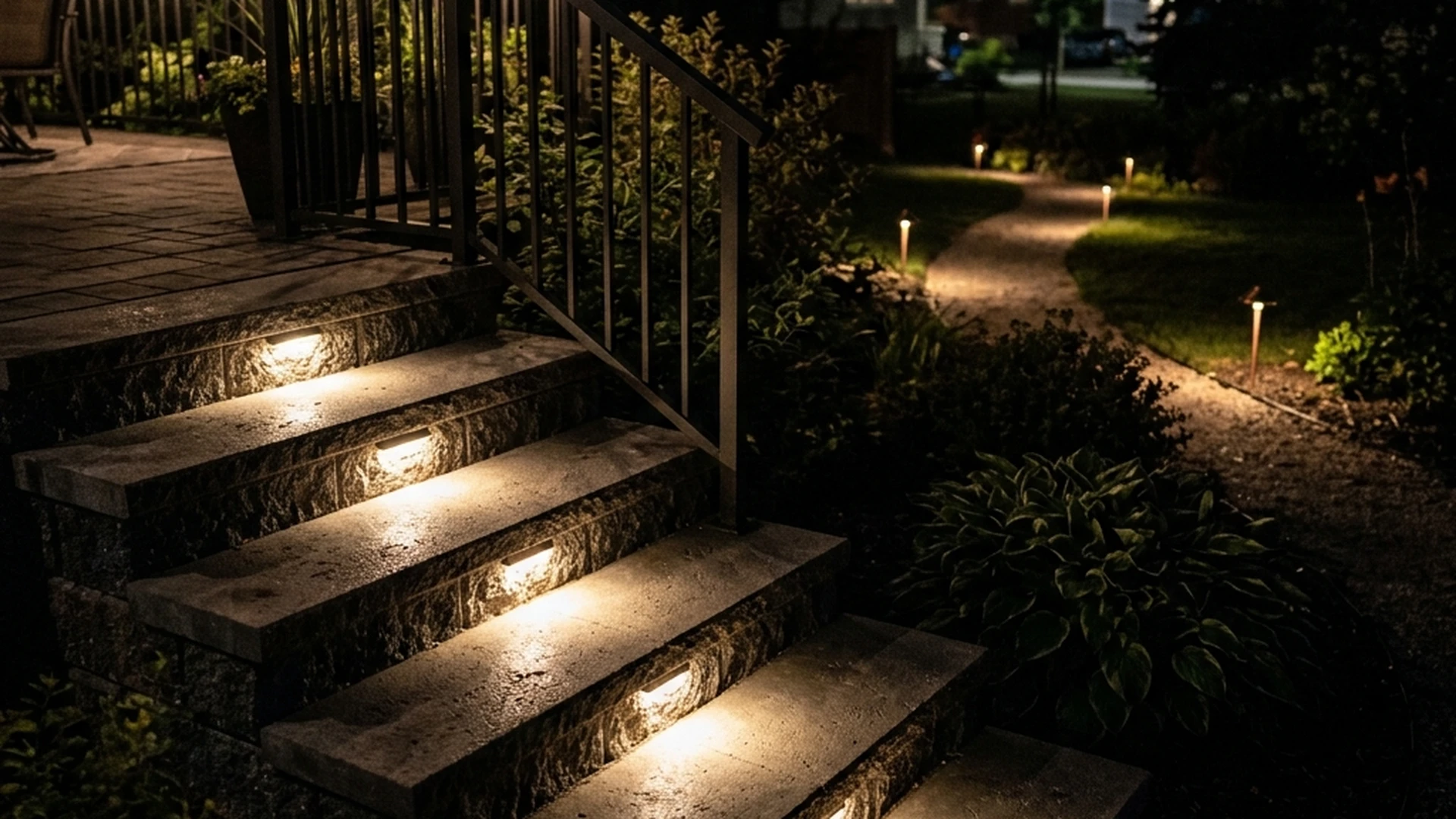
Path lights along the approach to the pool and patio from the house provide orientation and safety without needing to be the primary light source for the space, that’s the ambient layer’s job. Path lights should be low and directional, illuminating the walking surface rather than projecting light upward into the eyes of someone walking the path.
Spacing: path lights work best at 6 to 10 feet apart on alternating sides of the path rather than directly opposite each other. Directly opposing lights create a runway effect that looks institutional. Staggered placement creates a more natural-feeling path.
Steps are the highest-risk trip hazard in a pool area, particularly wet steps from the pool to a grade-change on the patio. Step lights recessed into the riser face or mounted on the side of the step structure illuminate the tread edge, the critical visual cue for safe step navigation, without requiring overhead lighting that creates harsh shadows.
Winnipeg-specific requirement: step fixtures must be rated for freeze-thaw and wet exposure. The riser pocket where a recessed step light sits accumulates water and experiences direct freeze-thaw stress. Fixtures not rated for this will fail within one to two seasons.
Low-profile fixtures set into or along the pool coping define the water edge after dark. This is a safety function first: the visual distinction between the patio surface and the water edge is critical when the pool is in use at night. It is also an aesthetic function: lit coping creates a continuous illuminated border that defines the pool shape and reflects in the water surface.
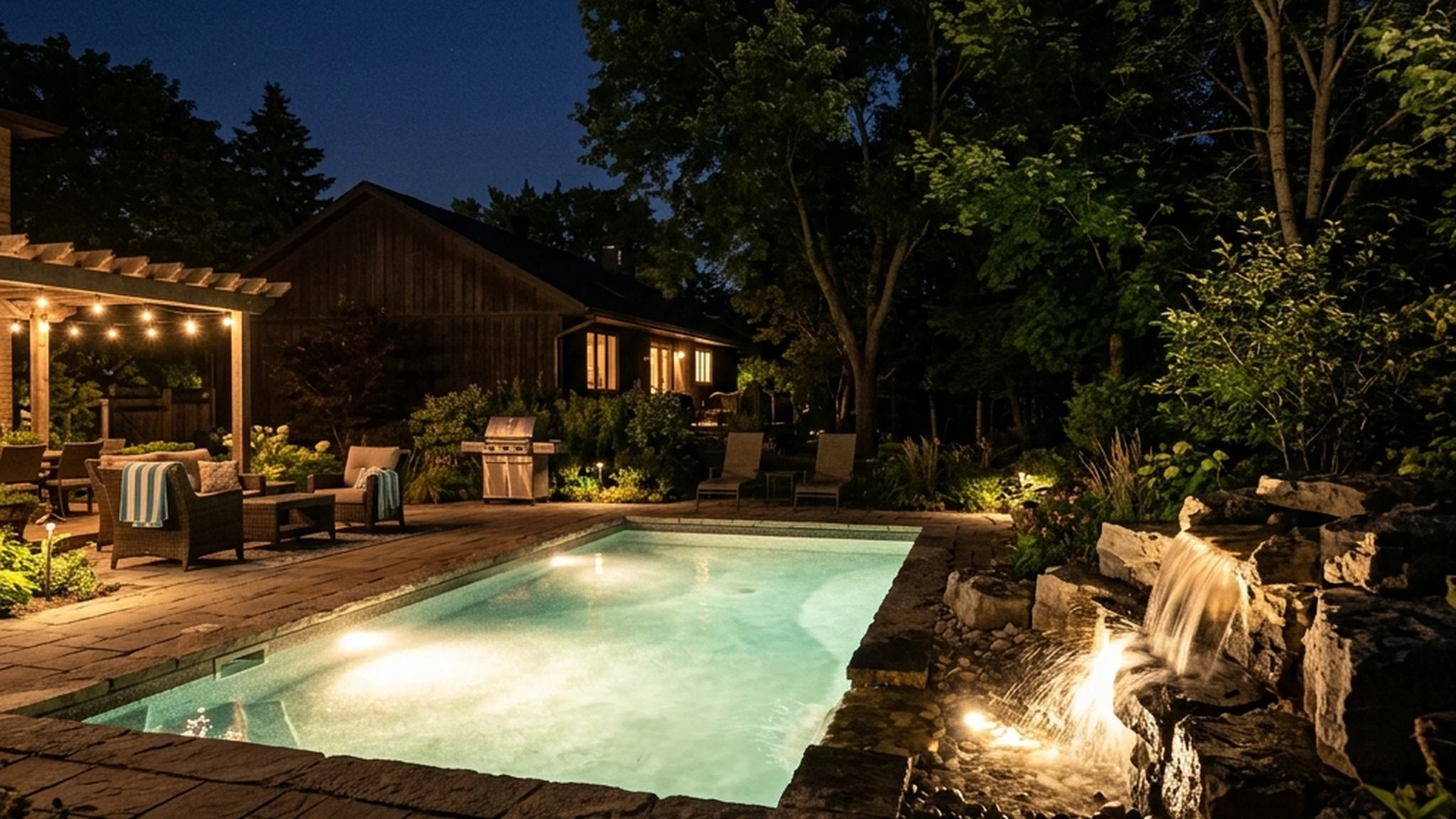
Accent lighting is the creative layer. It highlights specific features, creates visual interest, and adds depth to the space. In a pool and patio setting, the primary accent opportunities are the underwater pool lighting, any water features adjacent to the pool or patio, and specific planting elements that reward individual attention.
Underwater pool lighting is specified and installed during pool construction as part of the pool installation scope. LED underwater fixtures are the current standard: lower energy consumption, significantly longer service life, and the ability to produce colour-changing effects that static incandescent fixtures cannot. The number, placement, and wattage of underwater fixtures are engineering decisions made by the pool installer based on pool size and depth.
What the landscape contractor designs is the electrical connection from the pool’s low-voltage transformer to the pool equipment, and the relationship between the pool lighting and the surrounding landscape lighting circuits. Ideally, pool and landscape lighting run on coordinated control systems so the entire space can be managed with a single scene setting.
A pondless waterfall or fountain near the pool or patio benefits from a directional accent light positioned to illuminate the water in motion. A well-positioned fixture catching moving water creates a visual focal point after dark that is significantly more dramatic than the daytime effect. Position the fixture at an angle to the water flow rather than directly behind it, which tends to wash out the water’s texture. See our water feature installation guide for water feature types that pair well with accent lighting.
A statement boulder, an ornamental tree near the patio edge, or a specific planting feature that defines the space visually during the day deserves individual accent treatment at night. A narrow-beam spotlight aimed at a single specimen creates a focal point that draws the eye and adds visual depth to the overall space.
Pool and patio lighting in a well-designed system is not switched on and off as a single block. Different layers benefit from different timing and intensity. The ambient layer might come on at dusk and run until midnight. The task layer might be lower intensity or motion-triggered. The accent layer might be reduced to just underwater lighting after guests leave.
Smart landscape lighting controllers allow scene setting, scheduling, and remote control that was previously only available in high-end commercial installations. For a pool and patio setting where the space is used regularly and the lighting experience matters, a smart controller is worth the modest premium over manual timers.
All wired landscape fixtures in Winnipeg must account for freeze-thaw. Key considerations for pool and patio installations:
Buried wire conduit must be at an appropriate depth to prevent freeze damage. Consult with the electrical contractor on appropriate burial depth for your specific installation.
Junction boxes and connection points near the pool equipment area must be weatherproofed and positioned where they will not flood during spring snowmelt.
Fixtures set in pool coping or steps must be specifically rated for freeze-thaw exposure; not all wet-rated fixtures are rated for repeated temperature cycling below zero.
Transformer and controller locations should be in a protected area, either interior or a weatherproof enclosure rated for Canadian winter conditions.
Can I add landscape lighting to an existing pool and patio without major disruption?
Yes, with varying degrees of disruption depending on the approach. Wireless solar path lights and plug-in low-voltage systems can be added without any trenching. Hardwired systems that require buried conduit involve some trenching but can typically be done along bed edges and under mulch with minimal patio disruption. The most disruptive addition is any fixture that needs to be set into the patio surface itself, like step lights or coping lights, which require cutting into existing hardscape.
How many fixtures do I need for a typical pool and patio?
This depends on the size of the space and the desired effect, but as a rough starting point: an average residential pool and patio installation might include 2 to 4 uplights on surrounding trees, 4 to 8 path lights on approach walkways, 2 to 4 step fixtures per grade change, and 2 to 3 underwater pool fixtures. Accent spots on specific features add as needed. The layering approach means fewer, better-placed fixtures outperform a larger number of undirected fixtures.
What colour temperature is right for pool and patio lighting?
Warm white (2700K to 3000K) for ambient and path lighting creates a welcoming evening tone. Cooler white (4000K) can work for safety-critical task lighting if a more functional appearance is acceptable. Underwater pool lighting in colour-changing modes spans the full spectrum, but default white mode in the 3000K range is the most commonly used for regular evening use. Avoid mixing widely different colour temperatures in the same space, as the contrast reads as mismatched rather than layered.
Lawn ‘N’ Order designs and installs landscape lighting systems for pool and patio settings across Winnipeg. Book a free consultation to discuss the lighting layer for your outdoor project.
Use the Free Calculator Book a Free ConsultationSend the address and a rough idea of scope. We'll walk it, take levels, and give you a written number you can compare line for line.
Keep reading

A plow truck, a pusher and a loader do three different jobs, and the pile you start in November is still there…
Read the article →
Holiday Light Installation Winnipeg: Book Before the Ground Freezes Quick Takeaways Holiday light installation in Winnipeg has a short window: crews install…
Read the article →
Who Clears the Sidewalk in Winnipeg? What the City Does and What You’re Responsible For Quick Takeaways Winnipeg is one of the…
Read the article →