Condo & Strata Snow Removal Winnipeg: What’s Different
- The defining difference is that a condo property has multiple categories of space with different responsibility attached: common elements the corporation clears, limited common elements that sit in a grey zone, and areas that belong to individual owners
- Decision authority is split between the board, the property manager, and in some cases the owners themselves, which changes how and when a contract can actually be signed
- Visitor parking and fire lanes are the two areas most likely to be under-specified in a condo snow contract and most likely to generate complaints or compliance problems
- Multi-building properties need a stated clearing priority. Without one, every building believes it should be first, and the crew is making that call in the dark at 4 a.m.
- Contract structures, trigger depths, response times and liability are covered in our commercial snow removal guide. This post is about what condo properties add on top of those.
Why a Condo Property Isn’t Just a Bigger Commercial Lot
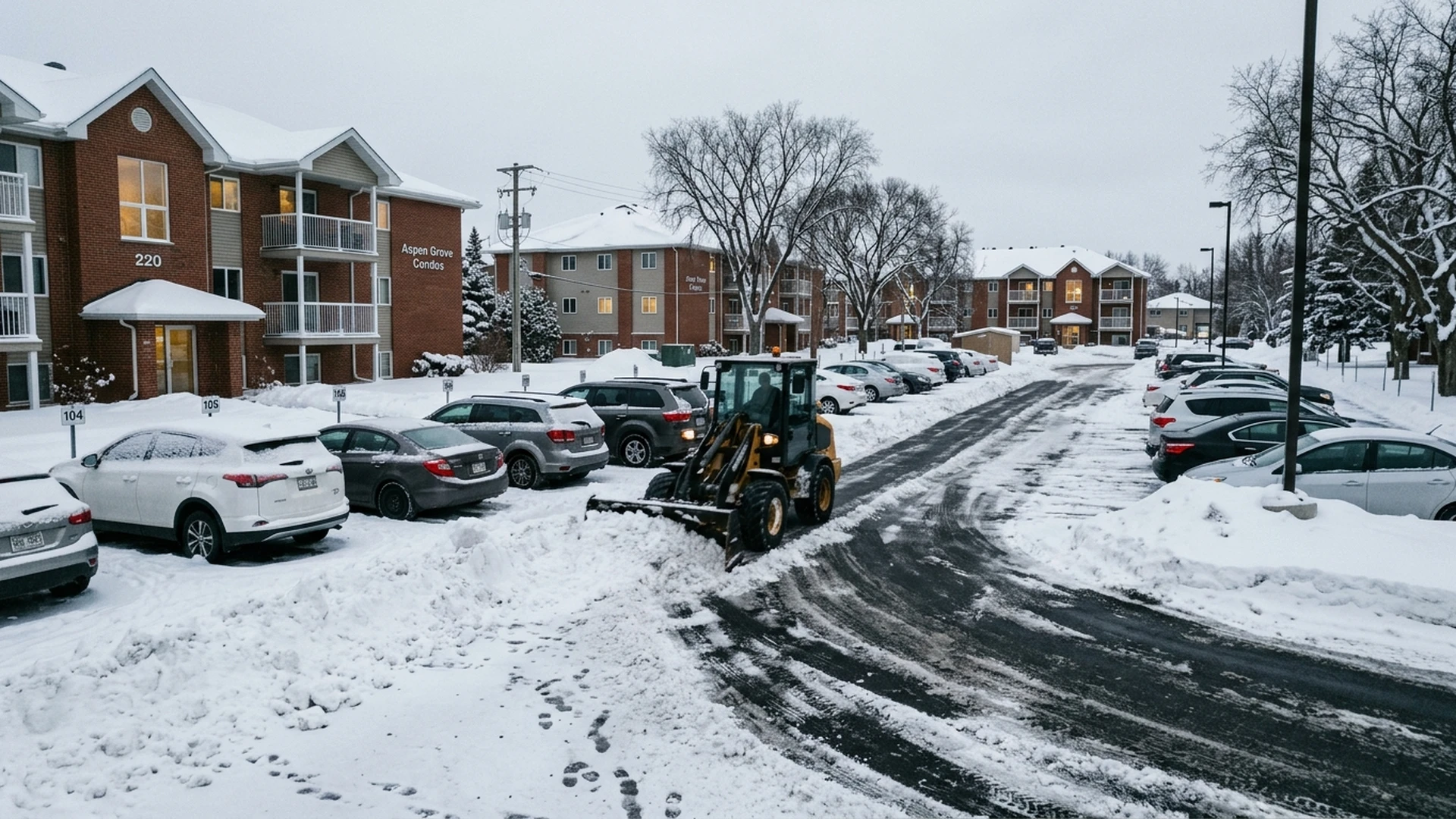
From a clearing perspective, a condo or strata property looks similar to any commercial site: parking, drive aisles, walkways, building entrances. The equipment is the same and the work looks the same.
What’s different is everything around the work. A single commercial lot has one owner or one manager who decides what gets cleared, approves the spend, and hears the complaints. A condo property has a corporation, a board, often a property manager, and dozens of owners who each have their own view of whether their particular walkway was cleared well enough. The ownership structure is the complication, not the snow.
The contract mechanics themselves, how per-event and seasonal pricing compare, what trigger depth to specify, what response time to commit to, and how documentation supports liability management, apply the same way here as on any commercial property. Those are covered in our commercial snow removal contracts guide. This post covers what condo properties add on top.
Common Elements, Limited Common Elements, and Owner Responsibility
Manitoba condominium properties divide space into categories, and the snow contract needs to be written against those categories rather than against a general description of the site.
Common Elements
Shared areas the corporation is responsible for: main drive aisles, visitor parking, shared walkways, building entrances, and shared amenity access. These are the straightforward part of a condo snow contract. The corporation owns the responsibility and the contract covers them.
Limited Common Elements
This is where condo contracts most often go wrong. Limited common elements are areas designated for the exclusive use of one unit but still technically part of the common property, and the classic examples in a Winnipeg condo are the driveway apron in front of an individual garage, a private patio, or a front step serving one unit.
Whether the corporation clears these or the owner does is a governance question answered by the declaration and bylaws, not by the snow contractor. But the contract needs to state the answer explicitly, because it determines both the scope of work and who fields the complaint when it isn’t done.
The practical failure: a contract that covers “all common elements” without specifying whether limited common elements are included. Half the owners assume their driveway apron is covered; the contractor priced the work assuming it wasn’t.
Owner Responsibility
Areas belonging to individual owners are outside the contract entirely, and it’s worth being explicit about that in owner communications rather than leaving it to be discovered mid-winter. Townhouse-style properties in particular tend to have more owner-responsibility area than owners expect.
Who Actually Decides
For a single commercial lot, the person who requests the quote is usually the person who can approve it. Condo properties are more layered, and knowing which layer a decision sits in prevents a lot of wasted time.
| Decision | Usually Sits With |
|---|---|
| Day-to-day service issues and coordination | Property manager |
| Approving a contract within the approved operating budget | Board, often through the property manager |
| Approving a contract that exceeds the budgeted amount | Board, and depending on the amount and the bylaws, potentially the owners |
| A significant service level change mid-season | Board |
| Anything requiring a special assessment | Owners, through the process the bylaws require |
The practical implication for timing: if the snow contract is likely to come in above what was budgeted, that needs to surface early enough for the board to handle the approval process before the season starts. A quote delivered in late October that requires an owner vote is a quote that arrives too late to act on.
Visitor Parking
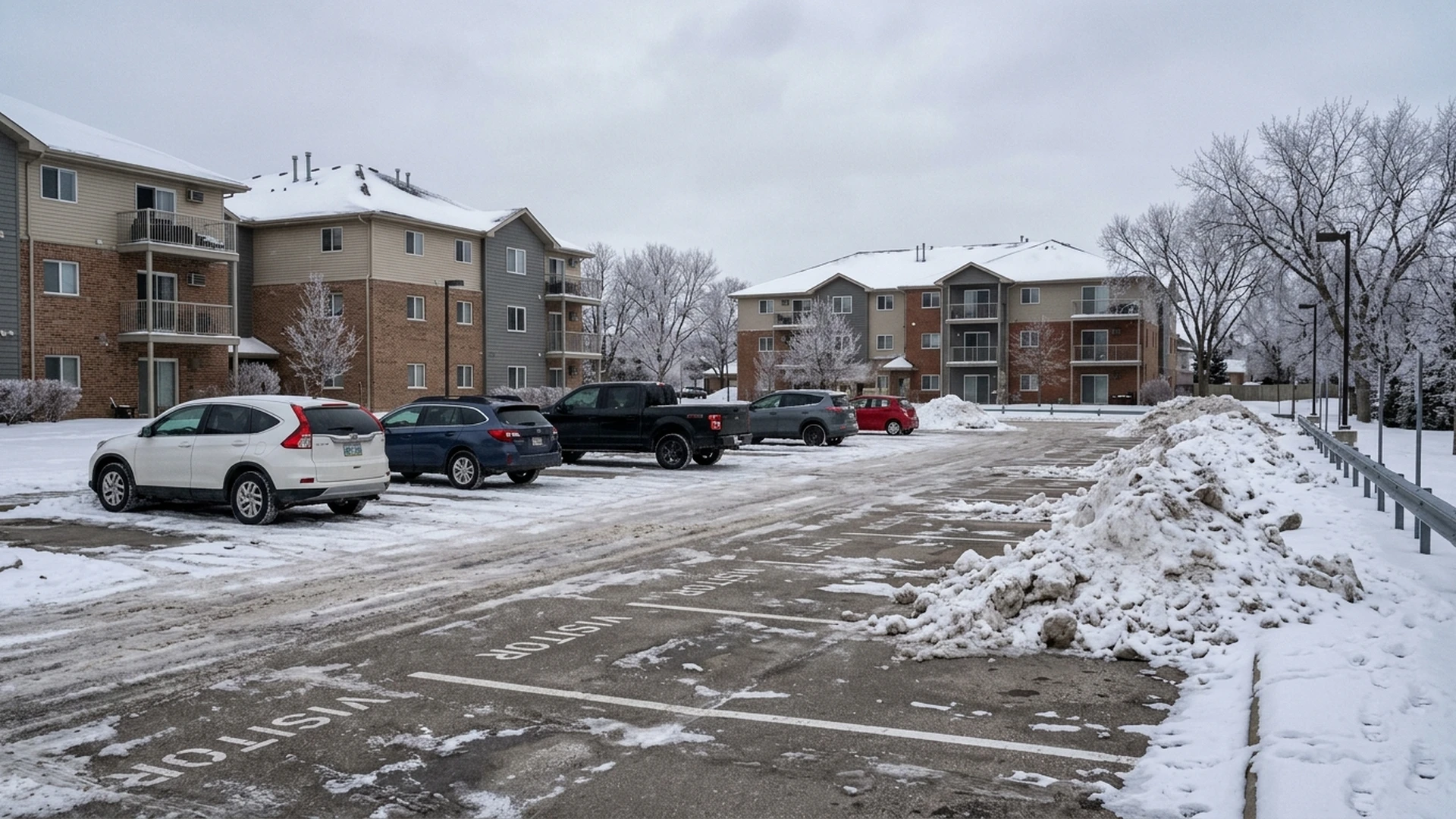
Visitor parking is the most commonly under-specified area in a condo snow contract and one of the more common sources of complaints.
The problem is that visitor stalls are shared space with no individual owner attached, which means nobody personally advocates for them until they’re unusable. They also frequently become the default snow storage location, since piling snow in visitor parking doesn’t inconvenience any specific owner the way piling it in resident parking would.
- Whether visitor parking is cleared to the same standard and on the same schedule as resident parking
- Whether visitor stalls can be used for snow storage, and if so, how many can be sacrificed before hauling is triggered
- Who monitors whether visitor parking is actually usable through the season, since no individual owner will report it
Fire Lanes and Emergency Access
Fire lanes and emergency vehicle access routes carry compliance obligations that don’t apply to ordinary parking areas, and they need to be identified in the contract rather than treated as generic drive aisle.
Practical points for a condo property:
- Fire lanes must remain clear and accessible, which means they cannot serve as snow storage regardless of how convenient the location is
- Access routes need adequate width maintained through the season, not just immediately after clearing. Piles pushed to the edges narrow the lane progressively as winter goes on.
- Hydrant access on the property needs to stay clear, and this is easy to overlook under accumulated snow
- Emergency access to building entrances matters as much as vehicle access to the property
These items should be named specifically in the scope of work so they’re part of the routine rather than dependent on an operator noticing them.
Multi-Building Properties and Clearing Priority
A property with several buildings faces a question a single-building site doesn’t: which building gets cleared first.
Without a stated priority, the crew makes that call on the ground, and whatever order they choose becomes a complaint from whichever building was last. With a stated priority in the contract, the order is a decision the board made rather than a decision an operator made at 4 a.m.
Considerations that reasonably drive priority:
- Buildings with a higher proportion of residents who leave early for work
- Accessibility needs, including units with residents who have mobility limitations
- Access sequence. Some buildings can only be reached through others’ drive aisles, which sets a practical order regardless of preference.
- Main entrance and the route emergency vehicles would take
A rotating priority across the season is one way to handle it if no building has a clear case for permanent first position, and it distributes the inconvenience rather than concentrating it.
Snow Storage on a Condo Property
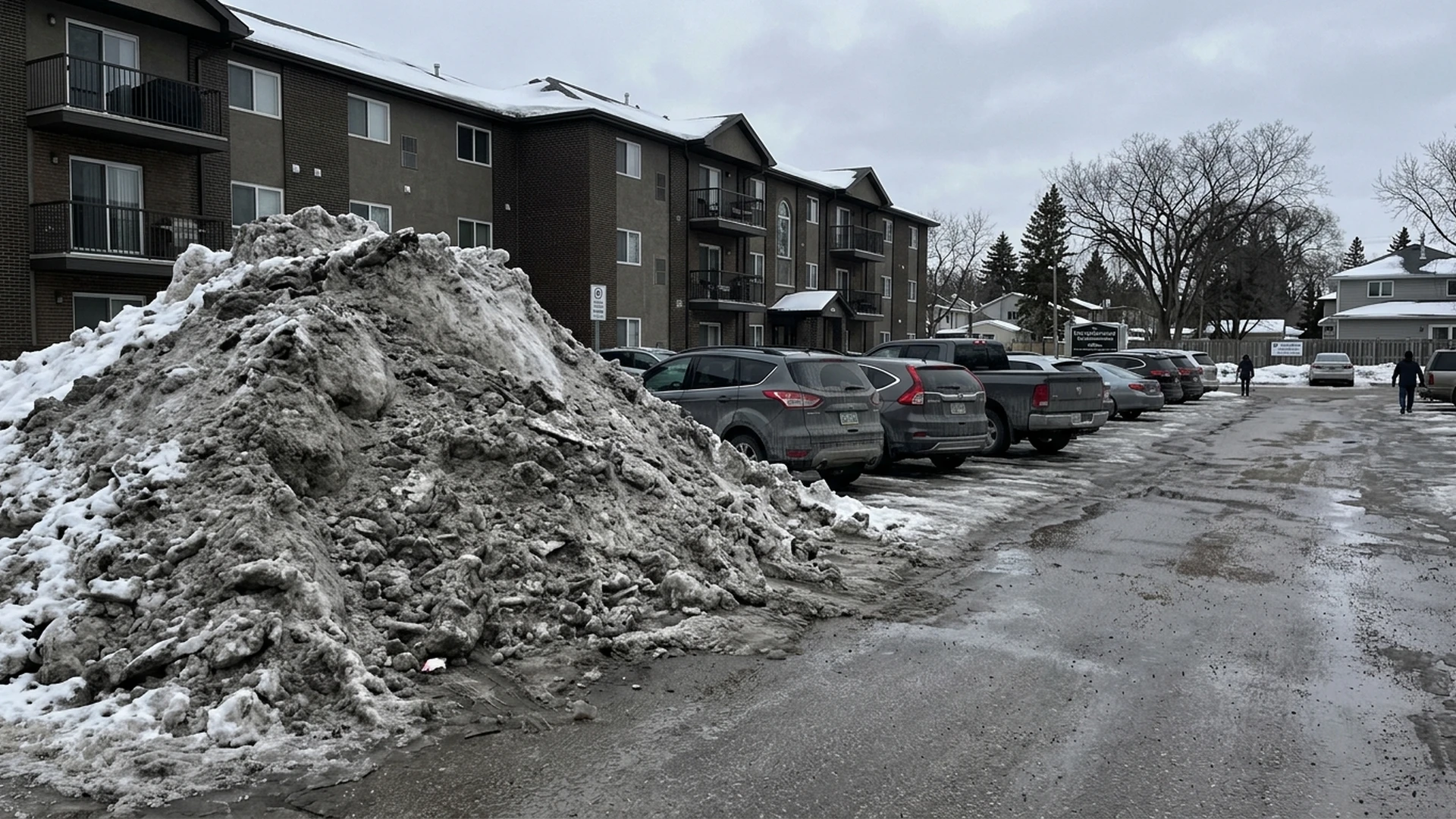
Where snow goes is a bigger question on a condo property than on a single lot, because there’s usually less unused land relative to paved area, and because every potential storage location is adjacent to somebody’s unit.
Worth designating in advance:
- Primary storage locations, agreed with the board rather than chosen by the operator
- Areas that are off limits: landscaped beds, over hydrants, in fire lanes, against building foundations, blocking unit windows
- The point at which storage capacity is exhausted and hauling needs to be triggered, so it’s a planned decision rather than a mid-winter emergency
For how snow hauling works once on-site storage runs out, including what triggers it and how it’s priced, see the snow hauling guide from our sister company Ditchfield.
Communicating With Owners
A condo snow contract has an audience the contract itself doesn’t reach. Owners experience the service, form opinions about it, and direct those opinions at the board and property manager rather than at the contractor.
A short owner-facing summary at the start of the season prevents a meaningful share of in-season friction. Worth including:
- What’s cleared by the corporation and what’s the owner’s responsibility
- The trigger, so owners understand why a light snowfall didn’t produce a visit
- Roughly how long a full clearing pass takes, so owners understand sequence rather than assuming they were skipped
- Where snow will be stored
- Who to contact with an issue, and what counts as an issue worth reporting
Service Area
Lawn ‘N’ Order provides snow removal primarily in West Winnipeg and surrounding areas. For condo and strata properties outside that area, call and we’ll confirm directly whether we can service the site.
FAQ: Condo and Strata Snow Removal in Winnipeg
Should limited common elements be in the contract or left to owners?
That’s a governance decision the declaration and bylaws answer, not one the contractor makes. What matters from a service perspective is that the contract states the answer explicitly. Either approach works as long as it’s documented and communicated to owners before the season, rather than becoming a dispute in January.
How far ahead should a condo board start on a snow contract?
Earlier than a single commercial property, because of the approval layers. If the quote might exceed the budgeted amount, the board needs enough time to work through whatever approval the bylaws require. Starting the conversation in late summer leaves room for that; starting in October often doesn’t.
Can one contract cover multiple properties under the same management?
Often yes, and property managers overseeing several condo corporations frequently prefer it for consistency and simpler administration. The caveat is that each corporation is a separate legal entity with its own board and budget, so the approvals still happen separately even if the service arrangement is unified.
Talk to Us About Your Property
Lawn ‘N’ Order provides snow removal for condo and strata properties, primarily in West Winnipeg and surrounding areas. Get in touch to discuss scope for your property before the season starts.
Use the Calculator Book a Consultation