Soil Movement & Frost Heave in Winnipeg Landscaping
You installed a perfectly level patio in August. By April, one corner sits 3 inches higher than the other. Your concrete curbing has a visible crack running its length. The walkway you laid last summer now has a noticeable hump in the middle.
Welcome to Winnipeg, where the ground doesn’t stay put.

This isn’t poor workmanship or defective materials. It’s frost heave—the upward soil movement caused when water freezes, expands, and literally pushes everything above it upward. Then spring arrives, things thaw, and structures settle back down… but rarely to their original positions.
Research data: National Research Council of Canada documents that Winnipeg experiences some of Canada’s most severe frost heave conditions. Our frost depth regularly reaches 1.8-2.4 meters, combined with clay-rich soils that hold moisture and heave significantly.
Understanding why this happens and how to design around it makes the difference between landscaping that lasts decades and landscaping that fails within seasons.
What Actually Happens Underground
Here’s the simple version: water in soil freezes. Ice takes up about 9% more space than liquid water. When water in soil pores freezes, it expands. That expansion pushes everything upward with surprising force.
But it’s more complex than that. The real problem is ice lens formation. As ground freezes from the surface downward, water in lower soil layers is drawn upward through capillary action toward the freezing front. This water freezes in layers (lenses) that can grow several centimetres thick. These ice lenses create the majority of the heaving force.
The force involved: Research from the University of Manitoba’s Civil Engineering department found that frost heave forces can exceed 100 kPa—that’s over 2,000 pounds per square foot. No residential structure built on affected soil can resist that force. The structure moves upward. Period.
Come spring, ice melts. The soil settles. But here’s the problem: it doesn’t settle uniformly. Areas with more moisture heaved more and settled differently than drier areas. Structures end up tilted, cracked, or displaced.
Multiple freeze-thaw cycles compound the problem. Winnipeg typically experiences 8-12 complete cycles between November and March. Each cycle creates incremental damage. After 3-5 years, that “minor settling” becomes “needs replacement.”
Where Frost Heave Hits Hardest in Your Yard
Walkways and Paths
Walkways sit right in the frost action zone—shallow depth, exposed to surface water, and usually not engineered to resist heaving. Interlocking pavers, flagstone paths, and even poured concrete walkways all experience movement.
The worst areas: Anywhere water accumulates before freezing. Low spots in walkway profiles, areas at the bottom of slopes, and locations where downspouts discharge nearby. These zones have maximum moisture availability feeding ice lens formation.
Concrete Curbing and Edging
Decorative concrete curbing looks fantastic when first installed. But it’s essentially a continuous rigid beam sitting in frost-susceptible soil. When different sections heave at different rates (which they will), the curbing cracks.
Curbing along driveways faces additional challenges. Snow piled against the curbing melts during sunny winter days, adding moisture exactly where you don’t want it. That moisture refreezes overnight, creating ice lenses specifically under curbing.
Patios and Decks on Grade
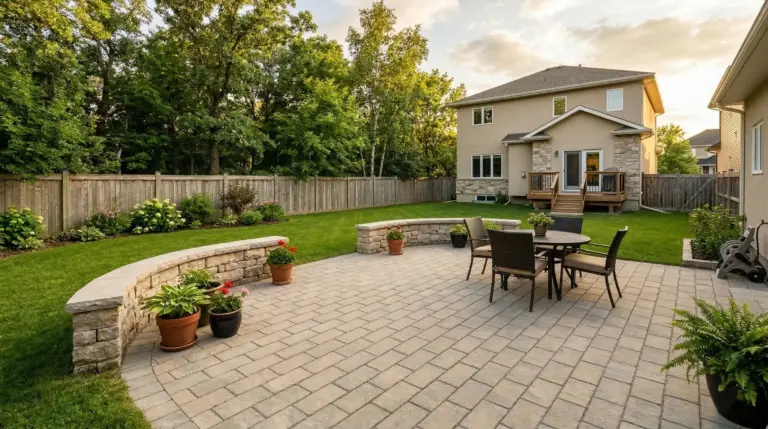
Ground-level patios and decks without deep frost-protected foundations move with the soil. Stamped concrete patios are particularly vulnerable—they’re solid slabs that must move as units, creating visible cracks when differential heaving occurs.
The corners and edges of patios heave most. These areas have exposure to moisture from multiple directions and experience greater temperature fluctuations than interior areas.
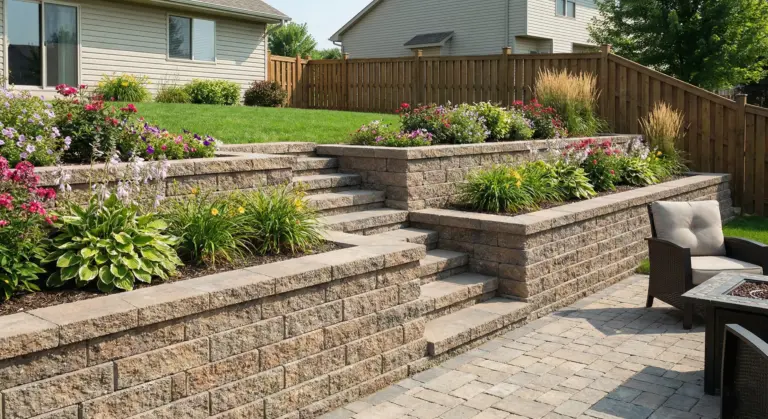
Retaining Walls (Short Ones Especially)
Short retaining walls—the kind around raised garden beds—sit entirely within the frost zone. They experience both direct frost heaving AND frost pressure pushing horizontally from behind.
Design Strategies That Actually Work
Proper Grading and Drainage
This sounds basic, but it’s the single most effective frost heave prevention. Remove moisture availability, and you dramatically reduce ice lens formation.
- Slope surfaces away from structures at a minimum 2% grade
- Ensure downspouts discharge at least 1.5 meters from landscaping features
- Direct surface water away from walkways, patios, and curbing
Manitoba Infrastructure research shows proper drainage reduces frost heave damage by 60-70%. That’s more effective than any exotic structural solution.
Base Material Selection and Depth
What sits under your patio or walkway matters enormously. Frost-susceptible soils promote heaving. Coarse, free-draining materials resist it.
The standard approach: excavate frost-susceptible native soil, replace with compacted granular base. For Winnipeg, we’re talking 30-45 cm of properly compacted Class 5 or similar granular base.
Ditchfield Soils provides properly graded base materials spec’d for frost resistance—clean materials with minimal fines content that drain effectively and resist ice lens formation.
Design for Movement, Not Rigidity
Some movement is inevitable. Smart design accommodates rather than resists it:
- Walkways: Use segmented construction (pavers, flagstone) rather than continuous concrete
- Curbing: Include expansion joints every 3-4 meters
- Patios: Include control joints and reinforcement if using concrete
- Decks: Design pier foundations with adjustment capability
Frost-Protected Foundations
Structures you really don’t want moving need foundations below frost depth. In Winnipeg, that means 2.4 meters minimum. For residential landscaping, this is rarely economical—but for high-value features, it’s sometimes warranted.
What Homeowners Can Do (And Can’t)
Winter Actions That Help
- Keep snow cleared from against foundation walls, curbing, and permanent structures
- Manage ice melt product use carefully—it allows water to penetrate soil mid-winter
- Direct water away from landscaping features consistently
Winter Actions That Don’t Help
- Adding weight to heaving features—the forces involved are too large
- Attempting repairs mid-winter—the ground is still moving
- Assuming the problem fixes itself, frost heave damage is cumulative
Spring Assessment and Action
April and May, afterthe spring thaw completes, are the right times to evaluate frost heave damage and implement fixes.
For minor walkway or patio unevenness, releveling might be possible. For significant damage, proper fixes require addressing root causes (drainage, base materials, design) not just cosmetic repairs.
Professional Design Makes the Difference
Twenty years working in Winnipeg teaches you which shortcuts work and which cause problems three winters later. Frost heave mitigation isn’t complicated, but it’s specific.
Lawn ‘N’ Order designs and builds landscaping accounting for Winnipeg’s frost heave realities. Our installations use proper base materials, incorporate drainage solutions, and design details that accommodate inevitable movement without catastrophic failure.
Contact Lawn ‘N’ OrderWe also work with Ditchfield Soils for properly graded base materials and EcoBins for the removal of frost-susceptible native soils when necessary.
Frost heave won’t go away. We can’t eliminate it. But we can design around it, build to accommodate it, and create landscapes that function reliably despite it. That’s the difference between landscaping that lasts 5 years and landscaping that lasts 50.
Related Resources
- Lawn ‘N’ Order Landscaping Services
- Ditchfield Soils Base Materials
- National Research Council Canada: Frost Heave Research
- Winter Landscape Maintenance Guide
Understanding frost heave doesn’t prevent it, but it informs smarter design decisions that work with Manitoba’s climate reality instead of fighting against it.